
The queries that trigger AI Overviews are already in your Search Console
Seven regex filters that pull conversational, AI Overview-triggering queries out of Google Search Console, and how to turn that export into a prompt list built from real demand.
I believe in a future where Google shows no blue links at all. And where nobody reads a landing page any more.
That is not a prediction for 2030. The behaviour has already shifted, and the useful part is that you can measure it today — in Google Search Console, with a tool most marketing teams have had open for a decade and stopped looking at.
The shift is already in the data
Bain & Company found that 80% of consumers now rely on AI-written results for at least 40% of their searches, which has cut organic web traffic by 15% to 25%. Around 60% of searches now end without the user going anywhere else.
The average across all searches hides the part that matters. When an AI Overview is present, 83% of searches end without a click, against 60% for searches without one — a 23-point gap that shows exactly where the exposure sits: any informational content an AI Overview can summarise. In AI Mode, the zero-click rate reaches 93%.
So the question is no longer which keywords you rank for. It is which questions you appear inside — and, immediately after that, what gets said about you there.
The first half of that is answerable today, for free, in about twenty minutes.
What a query that triggers an AI Overview looks like
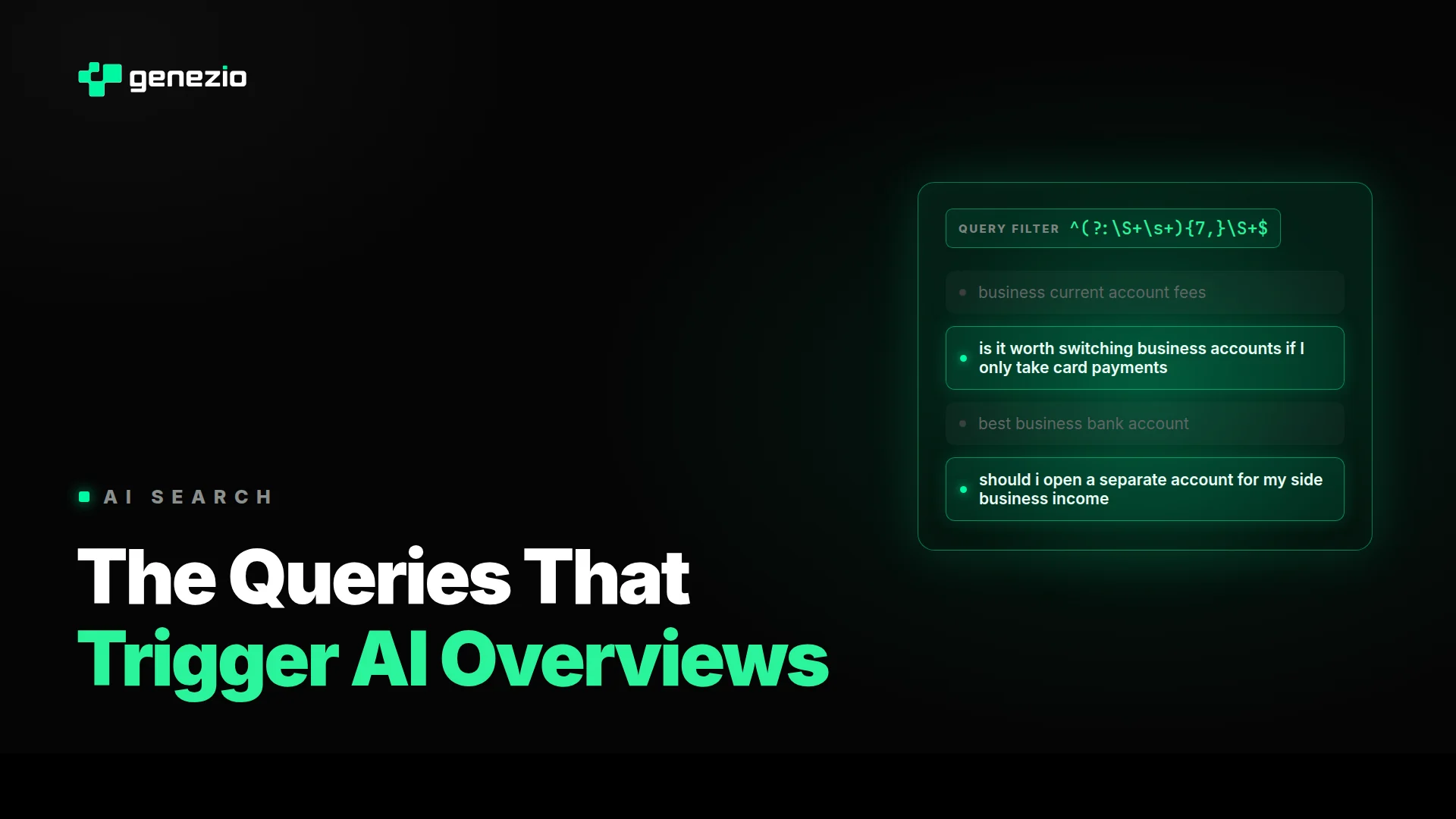
When people know what they want, they type three words. "business current account fees." Google returns ten links and the user picks one.
When people don't know what they want, they type sentences. "is it worth switching business accounts if I only take card payments." There is nothing for Google to list here — it has to synthesise. That is where the AI Overview comes from. And if the user wants to go further, Google moves them into AI Mode and the conversation continues without a single site being opened.
Those long, conversational queries are the same sentences people type into ChatGPT. The difference is that on Google, Search Console reports them back to you. They are already in your export, buried under tens of thousands of short keywords that drown the signal.
Seven regex filters that pull them out
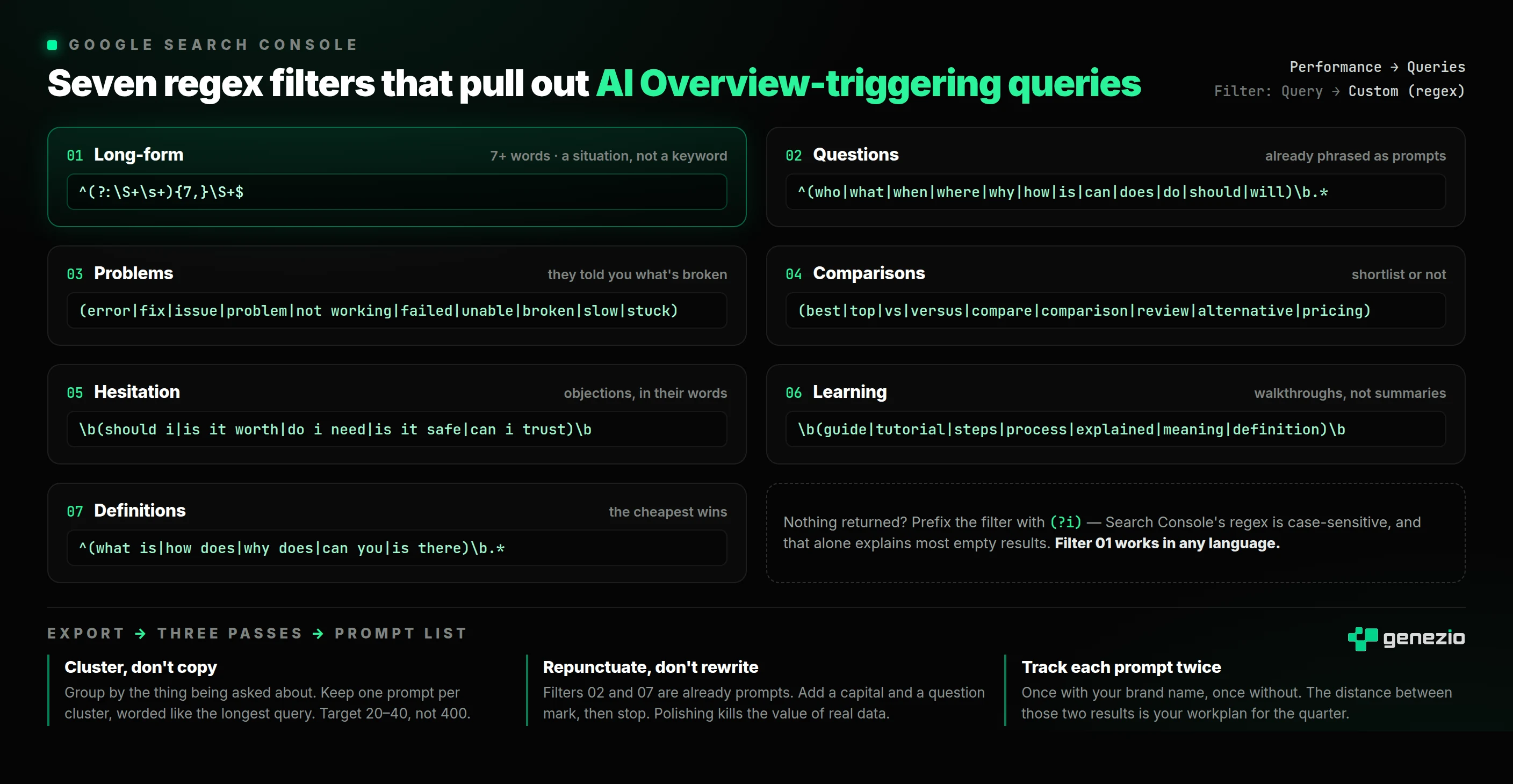
We run these on every brand we onboard. Paste each one into the Query filter in Search Console — choose Custom (regex) — and export the results.
01 — Long-form. ^(?:\S+\s+){7,}\S+$
Queries of seven words or more. Someone describing a situation rather than searching for a thing. The highest-value filter in the list, and usually the one nobody has run.
02 — Questions. ^(who|what|when|where|why|how|is|can|does|do|should|will)\b.*
They want an answer, not a list of links. Already phrased as prompts.
03 — Problems. (error|fix|issue|problem|not working|failed|unable|broken|slow|stuck)
They have already told you what's broken. You just explain the fix.
04 — Comparisons. (best|top|vs|versus|compare|comparison|review|alternative|pricing)
Buying decisions. This is where you are either on the shortlist or you aren't.
05 — Hesitation. \b(should i|is it worth|do i need|is it safe|can i trust)\b
Real objections, in the customer's own words. People thinking out loud, not shopping.
06 — Learning. \b(guide|tutorial|steps|process|explained|meaning|definition)\b
They want to understand it properly. Walkthroughs, not summaries.
07 — Definitions. ^(what is|how does|why does|can you|is there)\b.*
Short, clear explanations. The cheapest wins on the list.
If a filter returns nothing, prefix it with (?i). Search Console's regex is case-sensitive, and that alone explains most empty results.
For non-English markets, translate the word lists and keep the structure. Filter 05 in German becomes \b(lohnt es sich|brauche ich|ist es sicher|kann ich vertrauen)\b. The regex doesn't change; only the vocabulary does. Filter 01 works in any language without modification, which is why it is worth running first if you operate across several.
Turning the export into a prompt list
The raw export is not a prompt list. It is raw material. Three passes stand between them.
Cluster, don't copy. Four hundred queries are not four hundred prompts. Group them by the thing being asked about, then keep one prompt per cluster, worded like the longest query in that cluster — that one sits closest to natural speech. Twenty to forty prompts you can actually review every week is a realistic target. A list of four hundred is a list nobody opens twice.
Repunctuate, don't rewrite. Filters 02 and 07 come out as prompts already. Add a capital letter and a question mark and stop there. The moment you polish the phrasing, it stops being how people actually ask — and that was the entire value of pulling it from real data rather than writing it yourself.
Track each prompt twice. Once with your brand name in it, once without. The unbranded run tells you whether you get recommended at all. The branded run tells you what the model says once you have been named. The distance between those two results is your workplan for the next quarter.
Where Search Console stops
This is the limit of the free method, and it is worth stating plainly, because a prompt list on its own changes nothing.
Search Console tells you what is being asked. It does not tell you what is being answered.
You cannot see whether you appear in the AI Overview generated for that query. You cannot see whether you appear as a neutral mention or as a recommendation — and there is a large commercial difference between "options in this category include X" and "for your situation, X is the one to go with." You cannot see which sources the model pulled from, so you have no idea which levers would move the answer. And you cannot see what happens on the second and third turn, when the user continues in AI Mode and the model narrows its recommendation.
Your analytics will not close that gap either. One client was seeing 1,500 visits a month from AI in GA4. When we pulled their CDN logs, the real number was 150,000 conversations — a hundred times more than the tool they were making budget decisions on was reporting. The traffic was never missing. It was never being counted.
What we do with the other half
This is the part Genezio was built for.
We take that prompt list and run it as multi-turn conversations, as configured customer personas, across models and across geographies — because a single prompt fired once tells you almost nothing about a system that behaves differently depending on who is asking and what was said two turns ago.
Then we measure whether the brand is recommended, not just whether it appeared, and we report it with confidence intervals, so a number like 73.2% ± 4.1% means something you can act on rather than something you hope is directionally right. And we trace the citations behind those answers, so the question "why does the model keep suggesting our competitor for this" has an actual answer with a URL attached to it.
Start with the export
The prompt list you build out of Search Console is the strongest starting point available to you, because it is assembled from real demand rather than from a team brainstorm. It costs you two hours and no budget. Do that this week.
Then decide whether you want to know what happens to those prompts once they leave your spreadsheet.
If you want to see what Google and the major models are saying about your brand today, book a call and we'll walk you through your own data rather than a demo account.
Sources
- Bain & Company, Consumer reliance on AI search results signals new era of marketing, February 2025 — bain.com
- Bain–Dynata (December 2024) and Semrush (September 2025) on zero-click rates with AI Overview present and in AI Mode

Read more about GEO, AI Search & Testing
Are Brands Using Prompt Injection to Manipulate ChatGPT Recommendations?
Discover how marketers use prompt injection to hijack AI search responses, the security risks of black-hat GEO, and why it threatens brand reputation.
How a Leading Erste Group Bank Dominated AI Conversations
Discover how BCR, a key entity within the major European financial player Erste Group, adopted a GEO strategy to stay relevant for the new generation of users.
How to Prove and Defend AI Visibility Numbers to Leadership
How to validate and defend AI visibility numbers in front of leadership, prompt coverage, mention vs recommendation rate, citation evidence, competitor benchmarking, and pre/post content measurement.