
AI-Friendly Content Structure: Write for Chunks, Not Pages
Answer engines never read your whole page. They read a few hundred words cut out of it. Here is how retrieval pipelines slice content, and a structure that survives the cut.
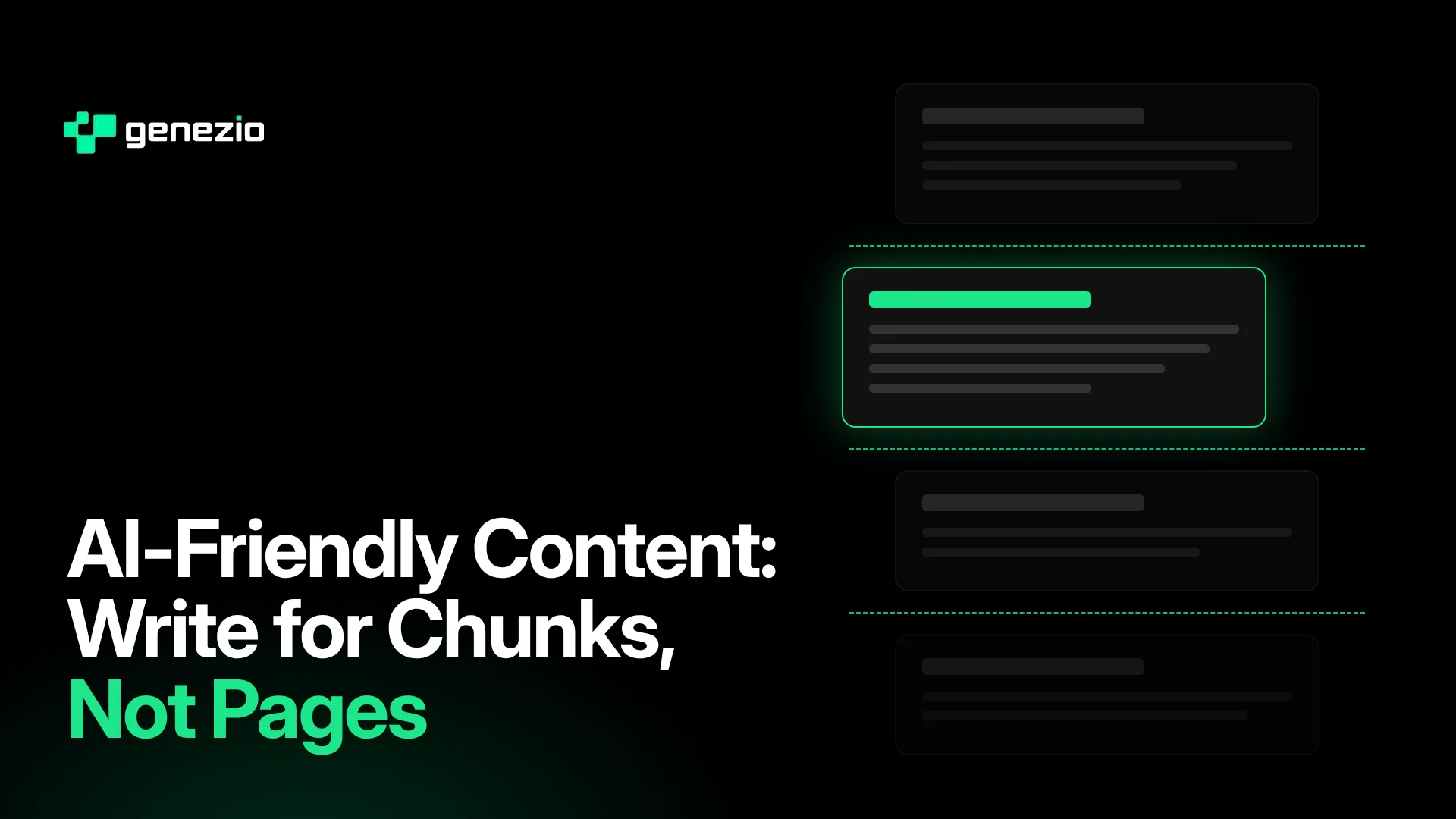
AI-friendly content is content where every section still makes sense after it has been cut away from the page. That is the whole rule. Answer engines split pages into chunks, retrieve a handful of them for each fan-out query, and hand only those chunks to the model.
Most advice on "structuring content for AI" stops at headings and FAQ schema. That misses the mechanism. If you understand what a retrieval pipeline does to your page, the structure rules follow on their own.
Genezio, a GEO platform that measures how AI answer engines describe and recommend brands, runs its own retrieval pipelines to audit brand websites the way answer engines read them. The rules below come from watching which passages survive that process and which get lost.
What happens to your page inside an answer engine
The exact pipelines are private, but the stages are well known, and we build the same stages ourselves:
- Fetch. A crawler downloads the raw HTML. Most AI crawlers do not execute JavaScript, so content rendered client-side never arrives.
- Clean. Navigation, footers and boilerplate are stripped. What remains is body text, headings, lists and tables.
- Chunk. The text is split into passages, usually at headings or at a fixed size of a few hundred tokens.
- Retrieve. Each fan-out query is matched against chunks by meaning and by keywords. A few dozen candidates come back.
- Rerank. A second model scores the candidates against the query and keeps the best few.
- Generate. The language model reads those few chunks, plus its own training, and writes the answer.
The model in step 6 sees your chunk, not your page. It does not see your title, your intro or the paragraph above. If a chunk says "it reduces costs by 30%", the model does not know what "it" is.
Six structure rules that follow from chunking
- Name the subject in every section. Write "Genezio's recommender agent" again, not "the tool" or "it." Repetition that reads clunky to a human is context to a chunk.
- Put the answer in the first sentence under each heading. Rerankers score how well a passage answers the query, and the opening carries most of that weight.
- Phrase headings as questions buyers ask. "How much does a GEO audit cost?" matches a fan-out query directly. "Pricing philosophy" matches nothing.
- Keep one idea per section, sized to fit a chunk: roughly 150 to 400 words. A section that covers three topics gets split mid-thought or scores low on all three.
- Use tables for attributes. Prices, specs, plan limits and comparisons survive chunking as tables and get quoted row by row.
- Attach numbers to units, dates and sources. "36% in one quarter" is quotable. "A big jump" is not.
A before-and-after example
Before:
Our approach is different. We don't just look at whether you show up. Instead, we go deeper, simulating how real people actually talk to these systems, which gives a much more accurate picture.
After:
Genezio measures whether ChatGPT, Claude and Perplexity recommend a brand, not only whether they mention it. It simulates multi-turn conversations as configured buyer personas, for example a procurement lead at a European bank, and reports the recommendation rate with a confidence interval.
The first version depends on the page around it: whose approach, deeper than what, which systems. The second can be retrieved alone and still answer "how does Genezio measure AI recommendations."
What helps less than you've been told
Schema markup helps classic search engines parse a page. We have not seen evidence that it changes which chunk a language model quotes. Use it, but don't expect it to fix weak passages.
llms.txt files are a reasonable convention, but no major answer engine has confirmed it reads them for answers. Treat them as optional.
Content hidden in tabs, accordions or "read more" toggles is a real risk. If it loads through JavaScript, most AI crawlers never see it. If it is in the HTML but collapsed, it is usually fine.
The chunk test, for agencies and in-house teams
Before publishing, copy each section under an H2 or H3 into a blank document. Then ask three questions:
- Does it say what it is about without the page title?
- Does the first sentence answer the heading's question?
- Would a buyer learn one specific fact from it, with a number or a name?
A section that fails any of the three needs a rewrite. Agencies selling "AI-friendly content structuring" can run this test on a client's top 20 pages in an afternoon, and it produces a concrete rewrite list instead of a generic audit.
How Genezio Content Analysis automates the chunk test
Genezio Content Analysis reads a page the way an answer engine does and tells you which sections would survive retrieval, before and after the page goes live. You paste a draft or a URL, and Content Analysis scores it on 8 checks that map to the pipeline above:
- Fetch. Content Analysis checks whether every major AI crawler can reach the page under your robots rules. It also compares the page before and after JavaScript runs, and lists the text that only a browser sees, so developers get the exact lines to move into the HTML.
- Retrieve. It checks whether the page covers the questions AI asks about the topic, so each section has a fan-out query to match.
- Rerank. It checks whether the page is structured to get cited, whether it is the kind of article AI cites for that topic, and whether it helps the brand without sounding like an ad.
- Generate. After publishing, Content Analysis maps the exact fragments AI engines quote back to the sections they came from, so you see which passages are retrieved and which are ignored.
Every check ends in a prioritized fix, for example "add a head-to-head comparison table naming the real alternatives in your category." For agencies, Content Analysis can start one analysis for each URL in a list, which turns a client's top 20 pages into a single rewrite plan.
Measure whether the structure worked
Structure changes are cheap to make and easy to fake success on. Track two things before and after: whether the page is cited in AI answers for its target questions, and whether the brand's recommendation rate moves for the conversations that page should influence. If citations rise and recommendations don't, the page is retrieved but not persuasive, and the next fix is the argument, not the formatting.
FAQ
What is a chunk in AI search?
A chunk is a passage of a few hundred tokens that an answer engine cuts out of a page, usually at a heading. The engine retrieves and ranks chunks, not pages, and the language model writes its answer from the few chunks that rank best.
How long should a section be for AI retrieval?
About 150 to 400 words, focused on one question.
Do FAQ sections help?
Yes, when each answer is self-contained and specific. A list of one-line answers adds little.
Should I rewrite old content or publish new pages?
Rewrite pages that already rank or get cited first. They are already in the retrieval set, so structure gains show up faster.
Should headings be phrased as questions?
Yes, for sections that answer something a buyer would ask. A heading like "How much does a GEO audit cost?" matches a fan-out query directly, while a label like "Pricing philosophy" matches nothing.
Does schema markup help a page get cited by AI?
Schema markup helps classic search engines parse a page, but we have not seen evidence that it changes which chunk a language model quotes. Keep it, and fix weak passages in the text itself.
Can AI crawlers read content inside tabs and accordions?
Usually yes, if the content is in the HTML and only collapsed. If it loads through JavaScript when the visitor clicks, most AI crawlers never see it.
How do I check whether my content is AI-friendly?
Run the chunk test: copy each section into a blank document and check that it names its subject, answers its heading in the first sentence, and gives one specific fact. Genezio Content Analysis runs the same checks automatically, on a draft or a live URL, and turns each finding into a prioritized fix.

Read more about GEO, AI Search & Testing
The queries that trigger AI Overviews are already in your Search Console
Seven regex filters that pull conversational, AI Overview-triggering queries out of Google Search Console, and how to turn that export into a prompt list built from real demand.
Are Brands Using Prompt Injection to Manipulate ChatGPT Recommendations?
Discover how marketers use prompt injection to hijack AI search responses, the security risks of black-hat GEO, and why it threatens brand reputation.
Marketing Agency Brand Presence in the Age of AI Search
Discover why AI brand presence matters for marketing agencies in 2026 and how to leverage AI visibility tools like Genezio to master generative search.