
Businesses in ChatGPT: What First-Party AI Data Means for GEO
OpenAI now lets companies claim their profile in ChatGPT and see mentions and clicks. Here is what that first-party data means for GEO, and how to use it with Genezio.
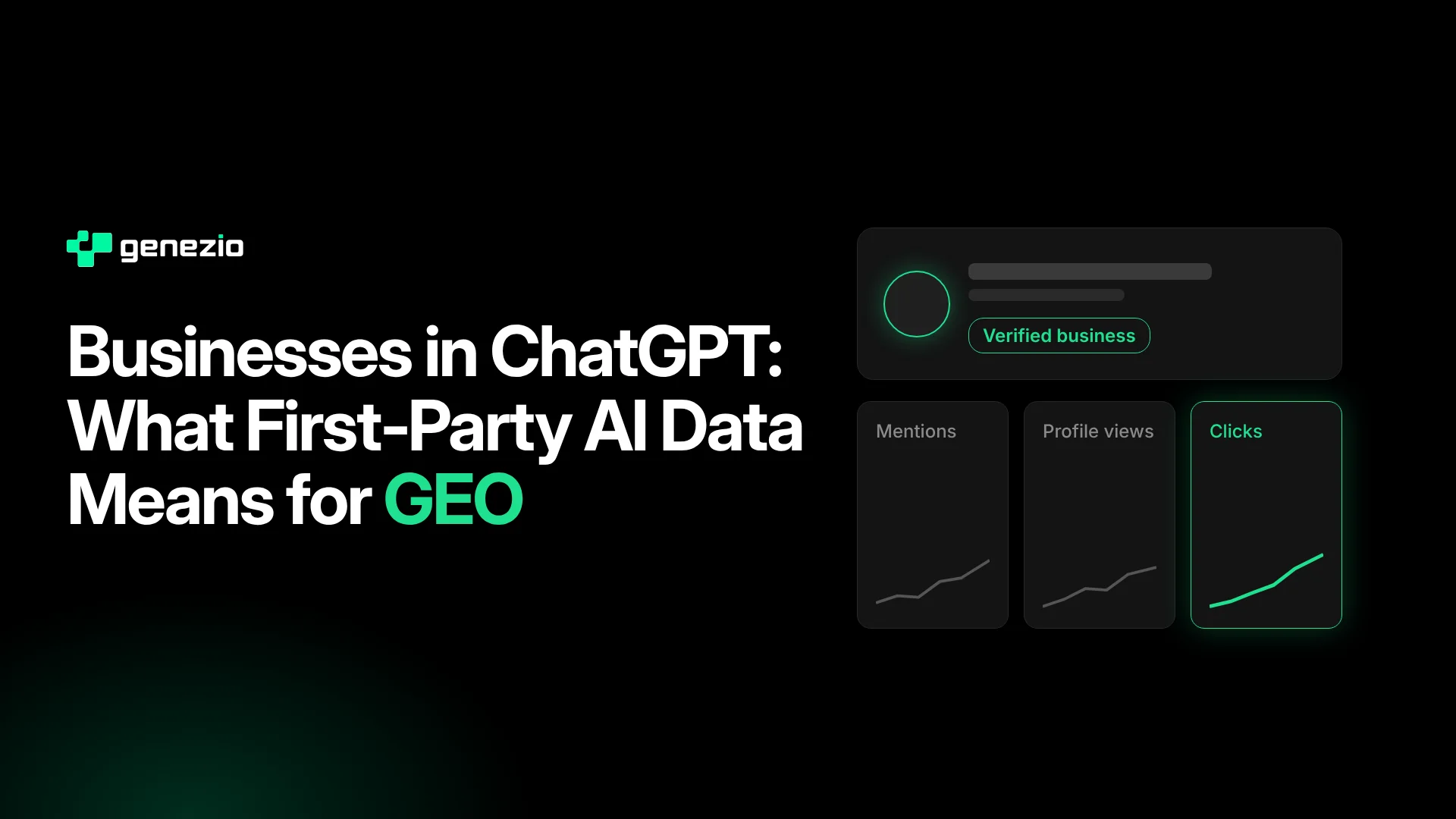
OpenAI launched Businesses in ChatGPT in beta on November 10. Companies can now claim their profile in ChatGPT and see how often it mentions them, how many people view that profile, and how many click through to their website.
At Genezio, we see this as a big step forward for GEO. When the most-used answer engine builds a home for businesses inside its own product, it shows where discovery is heading. More and more buying journeys will start in a conversation with an AI, and many will end there too.
It also brings a valuable new signal into GEO. Genezio measures how AI models recommend brands by simulating real customer conversations at scale. ChatGPT now adds first-party numbers from real users. Used together, they give brands a fuller picture than either one alone.
What you get today
Three things, all in beta:
- A verified business profile you claim and keep up to date.
- Analytics on mentions and clicks to your website.
- Business Agents: an AI agent that talks to your customers inside ChatGPT. Your profile can also be the landing spot for ChatGPT Ads.
OpenAI says ChatGPT reaches 1.2 billion people a week. Details will change during the beta, but ChatGPT is now a place where your brand has a presence, not just a mention.
Two views of the same customer
ChatGPT's dashboard tells you what happened: how many times your brand is mentioned, how often real users saw it, and what they did next.
Genezio tells you why. We monitor the buying journeys of your customer personas, following each one from first question to final choice in multi-turn conversations, across markets and against your competitors. We show the context of those mentions: whether they are positive, how prominently your brand is positioned, and how it compares to competitors mentioned in the same conversations. You also see why a competitor won, which sources the model trusted, and where you could show up next.
You need both. One shows your results; the other shows how to change them.
That's why we're working on integrating ChatGPT's business analytics into Genezio, so you'll see what happened and why it happened in one place.
Find the topics you're missing
Your Business Hub shows the topics where ChatGPT mentions your brand. Read that list two ways.
What's on it tells you where customers already meet you. Start your Genezio setup there, and check whether you're being recommended or only mentioned.
What's missing matters more. Say you're a bank that wants to come up when people ask about first-time mortgages, and that topic isn't on your list. You now know it from ChatGPT's own data. That gap is your roadmap.
Genezio shows you who gets recommended instead, which sources the model relies on, and what to change in your content and positioning. Then you watch the result in the same ChatGPT dashboard, as the topics you targeted start to appear.
That's a result you can take to your CEO: we weren't showing up for this, and now we are, according to ChatGPT itself.
Prove what AI is worth to your business
Attribution has been the hardest part of GEO for marketers. The gap can be striking. A site's GA4 might report about 1,500 visits a month from AI, while its CDN logs show 150,000 AI conversations, a hundred times more. AI is clearly shaping how customers find the brand, but analytics can't show it.
ChatGPT's mention and click data gives you first-party numbers from the engine itself. Combined with Genezio and your server logs, you can follow the whole path:
- What the AI says about you, and whether it recommends you: Genezio.
- What real users saw and did: ChatGPT's Business Hub.
- What reached your website: your server and CDN logs.
The sources also check each other. When Genezio's results line up with ChatGPT's real-world numbers, you can rely on them for the markets and competitors the dashboard doesn't cover. When they differ, you've found something worth looking into.
Test your Business Agent before your customers do
A Business Agent speaks for your company, to your customers, at scale. Before you launch one, you'll want to know: does it describe your products correctly, respect your policies, recommend the right offer, and sound like your brand?
A few test chats won't tell you. You need to test it the way customers will use it: many personas, many multi-turn conversations, repeated after every change.
Genezio does exactly this. The persona simulations we use to measure how AI talks about your brand also evaluate your own agent, and show where it drifts from what your business needs.
And before a customer ever reaches your agent, ChatGPT decides whether to send them to you or to a competitor. Genezio measures that too.
What to do this quarter
Claim your profile now. Your first months of data become the baseline for everything that follows.
List the topics you want to own and compare them with what ChatGPT reports. The difference is your priority list.
If you plan to launch a Business Agent, test it before your customers do.
The brands that pair ChatGPT's numbers with a clear picture of how AI recommends them will be the first to turn this new channel into growth.

Read more about GEO, AI Search & Testing
Are Brands Using Prompt Injection to Manipulate ChatGPT Recommendations?
Discover how marketers use prompt injection to hijack AI search responses, the security risks of black-hat GEO, and why it threatens brand reputation.
AI-Friendly Content Structure: Write for Chunks, Not Pages
Answer engines never read your whole page. They read a few hundred words cut out of it. Here is how retrieval pipelines slice content, and a structure that survives the cut.
The queries that trigger AI Overviews are already in your Search Console
Seven regex filters that pull conversational, AI Overview-triggering queries out of Google Search Console, and how to turn that export into a prompt list built from real demand.