
AI Visibility vs Recommendation: Mentions Aren't Enough
The digital marketing landscape has entered a new era. Traditional SEO is evolving into Artificial Engine Optimization (AEO). Discover why AI recommendation is the new standard.
Recommendation vs. Visibility: Why Being Mentioned by ChatGPT Isn't Enough
Introduction: The Evolution from SEO to AEO
The digital marketing landscape has entered a new era. Traditional Search Engine Optimization (SEO), once the pinnacle of discoverability, is rapidly evolving into Artificial Engine Optimization (AEO). AEO focuses on optimizing a brand's presence not just in search engine results pages but within the conversational AI and Large Language Model (LLM) driven interfaces that are becoming primary touchpoints for customer queries.
Today, marketers and brand managers are obsessed with "AI Visibility": simply being mentioned in ChatGPT, Google’s Bard, or Gemini responses. This focus is understandable given the hype around generative AI, but it is increasingly clear that mere visibility is a vanity metric. Being listed or mentioned in a ChatGPT response may increase brand awareness superficially, but it does not guarantee conversion or influence buyer decisions.
The real ROI lies in being explicitly recommended by these AI systems, endorsed as the best choice given a user’s specific intent. This definitive guide will explain why "AI Recommendation" is fundamentally different and more valuable than "AI Visibility," how Genezio’s proprietary technology measures and leverages this difference, and why your brand must pivot to tracking and increasing its AI recommendation share of voice to win in the new AI-driven marketplace.
The Paradigm Shift: SEO vs. AEO
The transition from Search Engine Optimization (SEO) to Artificial Engine Optimization (AEO) is a tectonic shift reshaping brand discoverability in an AI-first world.
- From Keyword Matching to Semantic Proximity: Traditional SEO emphasized keyword matching, ensuring content contained specific search terms to rank in engine results. In contrast, AEO demands a leap to semantic proximity, AI models interpret the meaning behind user queries and match them to conceptually relevant brand content. This shift requires brands to optimize for context, intent, and thematic relevance, transcending simplistic keyword presence.
- From Search and Browse to Prompt and Execute: User behavior is evolving from navigating multiple links (“10 blue links”) to engaging with conversational prompts that expect a single, precise, and trustworthy AI-generated response. Conversational AI streamlines the customer journey by executing intent almost instantly, prioritizing succinct, authoritative answers over exhaustive search result lists.
- LLMs as Zero-Click Gatekeepers: Large Language Models act as zero-click gatekeepers on the customer journey, providing direct answers within their interface without external clicks. Brands must now optimize not just for visibility but for selection as the definitive, trusted choice within the AI-generated output, essentially winning the zero-click conversion.
The Core Difference: AI Visibility vs. AI Recommendation
What is AI Visibility?
AI Visibility means your brand is mentioned or cited by an LLM when a user asks a relevant question. For example, if a user asks, "Where to shop for affordable and trendy clothes in the UK?" and ChatGPT responds, "Here are some options including ASOS, Zalando, and Marks & Spencer," your brand has achieved visibility. You appear among options shown to the user.
While being discovered is important, visibility alone is a passive metric prone to interpretation issues:
- The brand mention may come with caveats or negative contextual information.
- The mention might appear alongside competitor brands that are actively recommended.
- It does not imply any trust or preference by the AI in the brand's favor.
What is AI Recommendation?
AI Recommendation is a proactive endorsement by the AI system. It means the AI explicitly positions your brand as the best or most suitable option for the user's intent. Using the same project management example, a recommended brand might be the only one ChatGPT advises or the one it favors with detailed reasons why it’s better than alternatives.
The practical impact of recommendations is profound:
- Recommendations influence user decisions and increase the likelihood of conversions.
- They elevate brand authority and trust in the AI ecosystem.
- Being recommended means winning the AI-driven customer journey at the moment of purchase intent.
Why Marketers Must Care
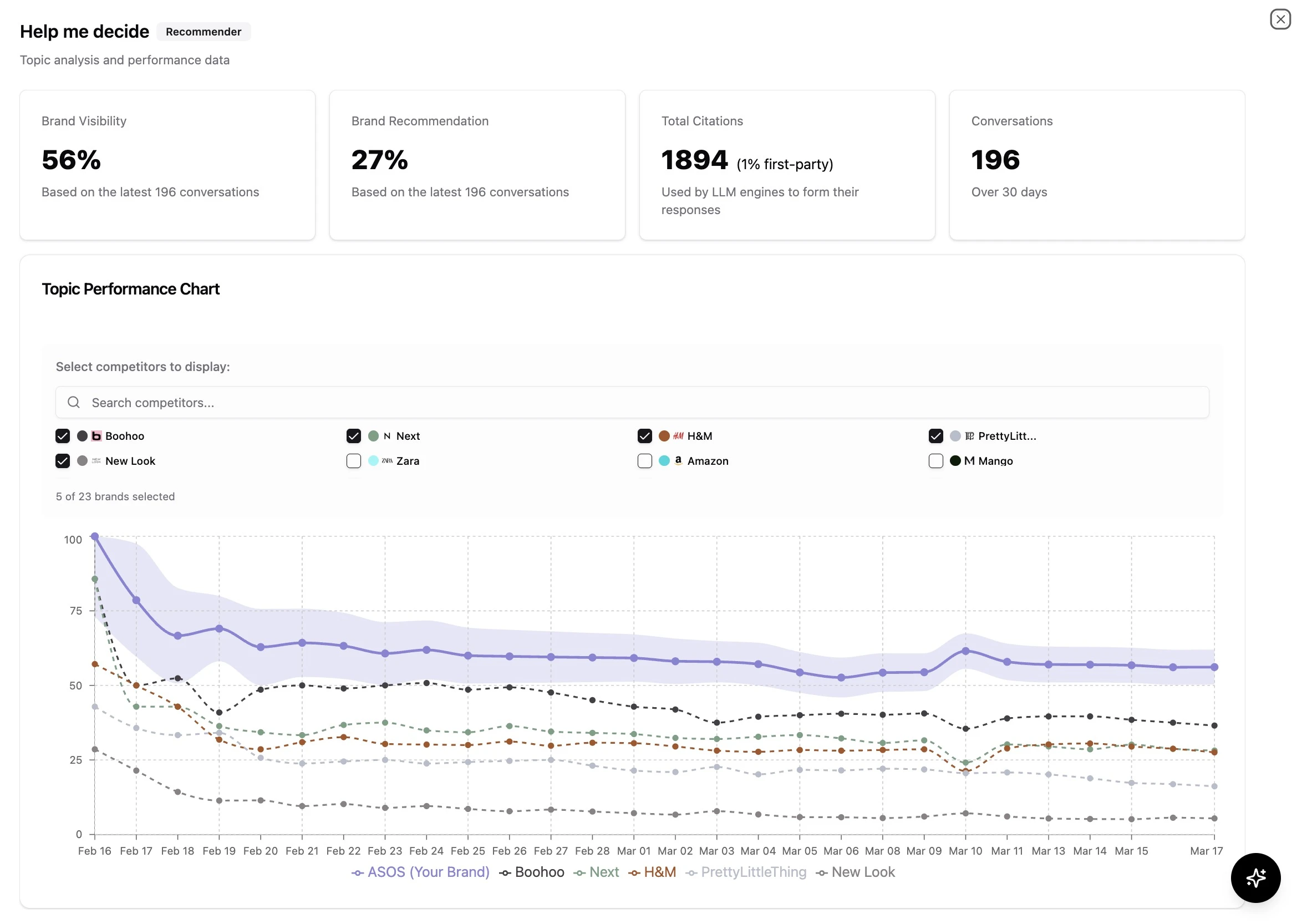
Data from Genezio's platform confirms a critical gap between visibility and recommendation. Many brands are frequently mentioned but rarely recommended. This disconnect means brands might be present in AI conversations but lose out to competitors who actually capture the top endorsement, and the customer.
The Technical Anatomy of "Visibility" vs. "Recommendation"
Understanding how LLMs generate responses is key to grasping the distinction between visibility and recommendation.
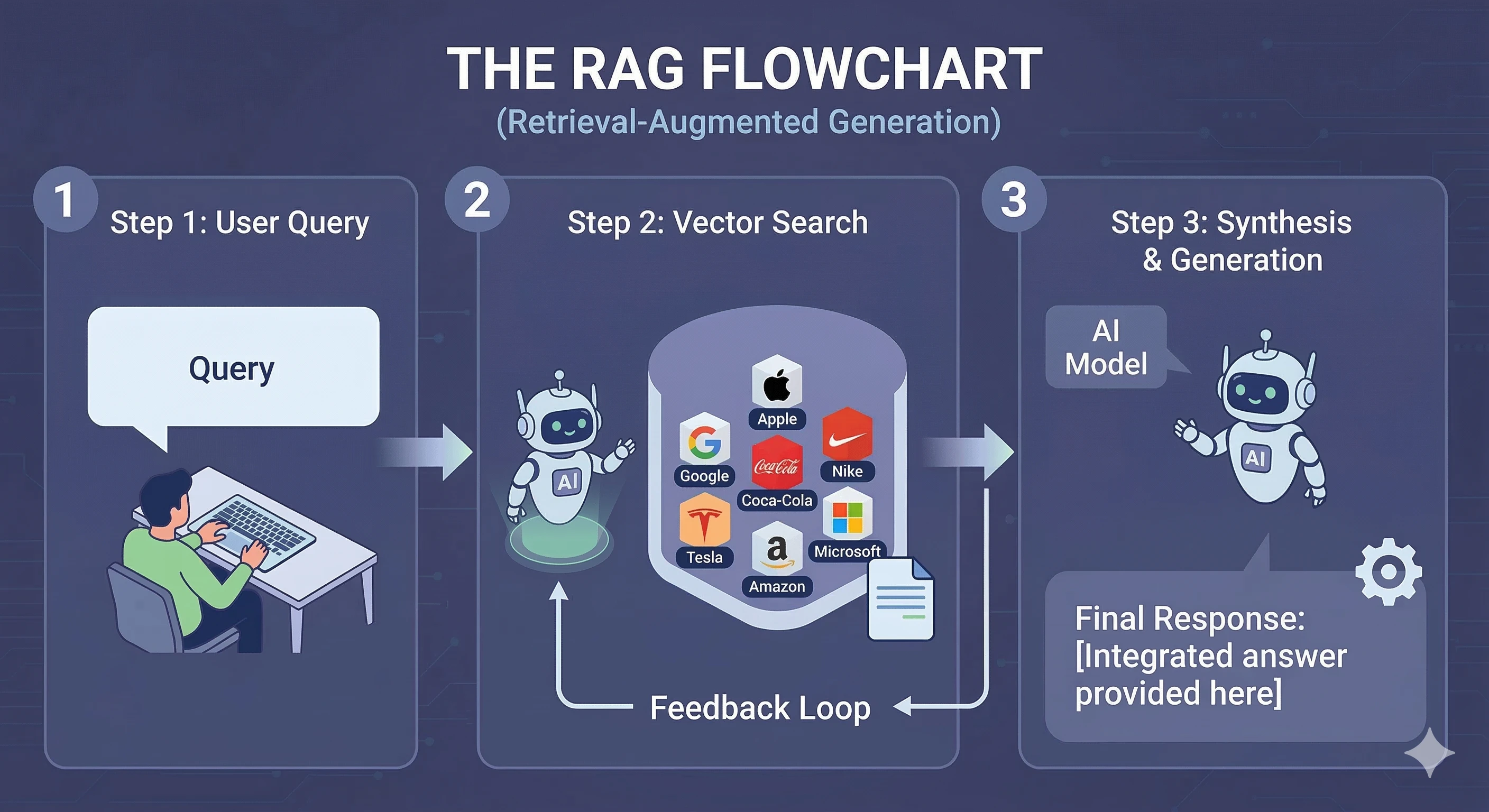
- Retrieval-Augmented Generation (RAG): RAG combines a pre-trained language model with a retrieval system that pulls real-time data from indexed web content. The AI scrapes and indexes relevant documents, then vectorizes the text into high-dimensional embeddings representing semantic meaning. During query resolution, the AI retrieves the most contextually relevant vectors to inform its answer.
- Visibility in LLM Terms: A brand is an entity stored in the vector database. When the AI retrieves relevant data, your brand can appear as part of a list or mention in the context window. This is visibility, inclusion without prominence or endorsement.
- Recommendation in LLM Terms: Recommendation means your brand’s entity holds high semantic weight and strong alignment with the user's intent. The AI’s attention mechanism assigns it positive sentiment vectors and authoritative relevance, positioning it as the definitive answer, often with justificatory context.
The 4 Pillars of AI Decision Making (Why LLMs Recommend)
LLMs evaluate brands through four crucial dimensions:
- Entity Authority: The frequency and quality of brand co-mentions with high-trust seed entities bolster perceived authority. Brands linked to recognized leaders and credible sources gain trust via association.
- Feature Matching & Contextual Nuance: AI matches nuanced user constraints (e.g., *"fast delivery to London"*and "sustainable") against detailed brand attributes mined from product specs, data feeds, and third-party content, ensuring tailored recommendations.
- Sentiment & Consensus: The LLM aggregates sentiment from diverse real-world signals like Reddit, reviews, and PR, synthesizing a collective opinion on brand reputation and suitability.
- Risk Aversion: LLMs filter out brands with ambiguous policies or poor reputations to minimize risk, prioritizing safe and reliable choices.
The Difference Illustrated: "Mentioned" vs. "Recommended"
Genezio runs sophisticated user-intent scenarios across multiple AI platforms to test brand handling in LLM responses. Here's what we've observed:
| Brand Status | Description | Example Scenario |
|---|---|---|
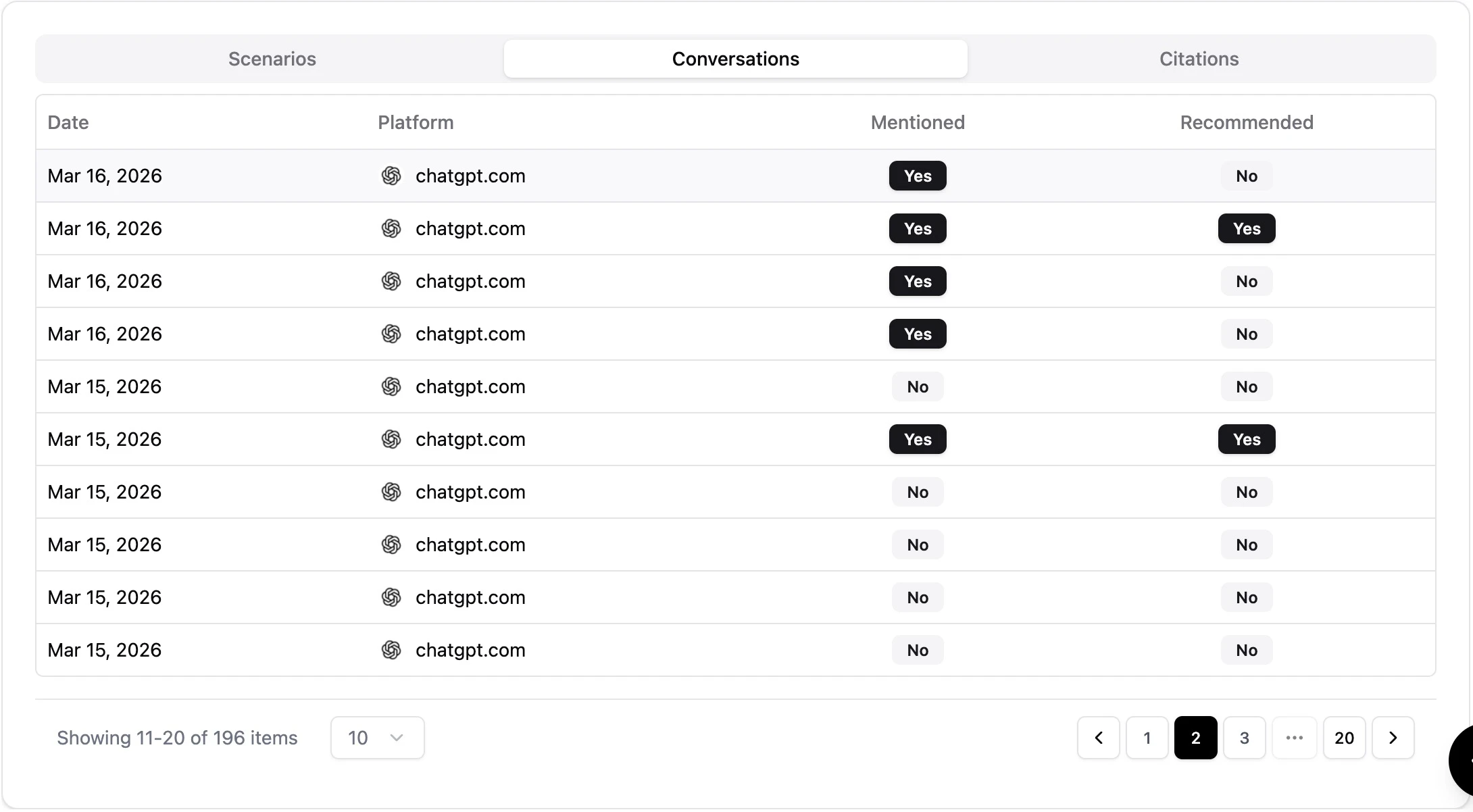
| Mentioned: Yes | Brand appears in list or discussion | ChatGPT lists Brand A but notes unclear sustainability |
| Recommended: No | Brand not actively endorsed | ChatGPT recommends Brand B as more eco-friendly |
This difference is crucial. Mentioned brands get exposure; recommended brands drive action.
The ASOS Case Study: Bridging the Gap Between Visibility and Action
To illustrate the chasm between mere visibility and active recommendation, let's examine proprietary Genezio data tracking ASOS. We tested how Large Language Models like ChatGPT handle highly specific user-intent scenarios, moving far beyond basic keyword searches.
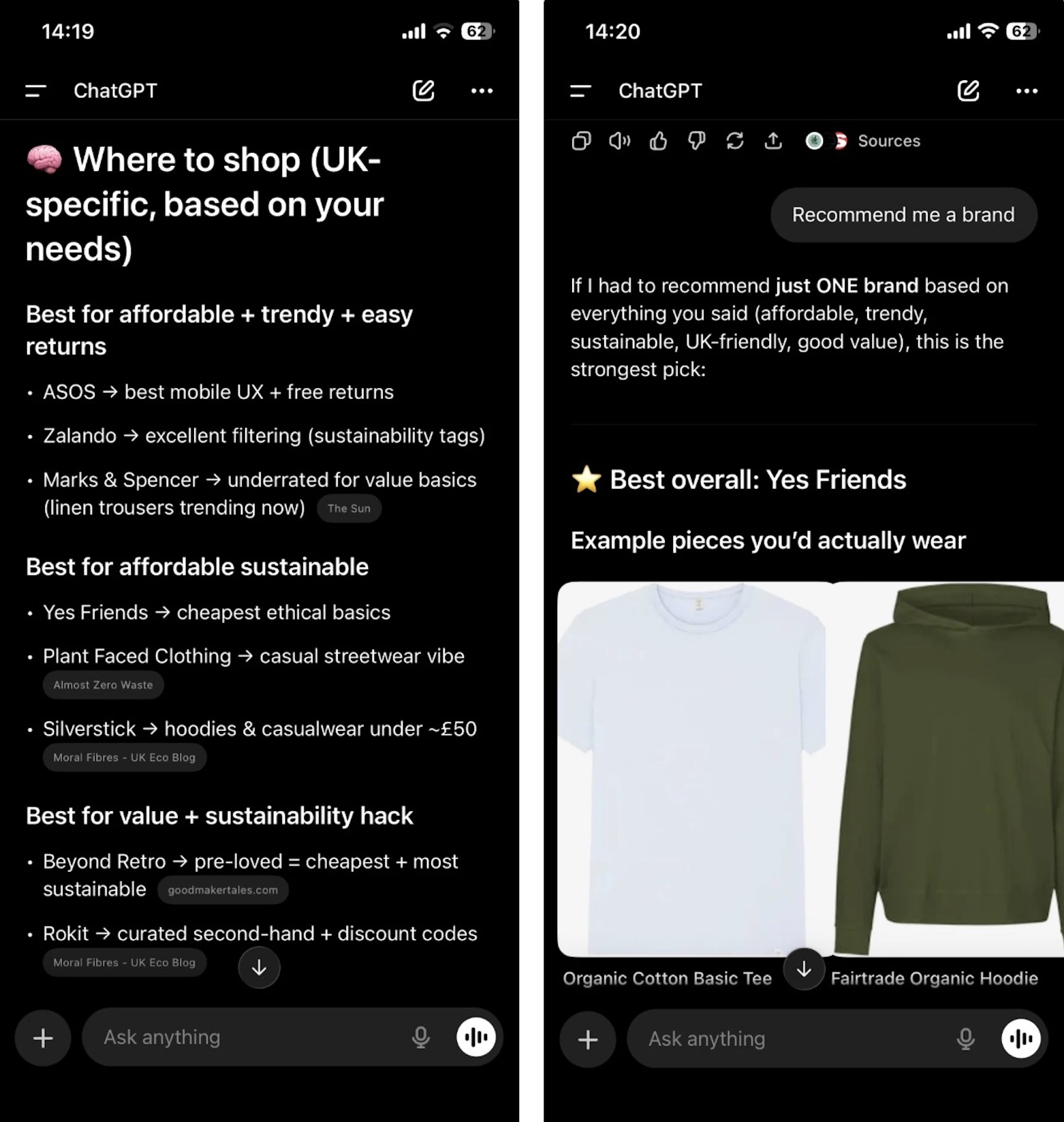
To do this, we utilized detailed query fanouts and complex scenarios that mimic nuanced, real-world consumer demands. Exact examples extracted from our testing show users "Looking for trendy and affordable women's clothing available online with delivery options to London," while explicitly instructing the AI to "Prioritize sustainable fashion lines and easy return policies." Other specific queries we tracked included targeted fanouts like "affordable summer dresses on sale that ship to London UK" and "affordable sustainable fashion brands UK."
When analyzing the 'Conversations' tracking data triggered by these prompts on platforms like ChatGPT, a crucial discrepancy immediately emerges. Our tracking logs reveal numerous instances where a brand's status registers clearly as "Mentioned: Yes" but crucially, "Recommended: No." This phenomenon happens when the AI brings a brand into the user's context window, acknowledging that it exists within the requested category, but firmly refuses to actively endorse it as the right choice. The AI might list the brand neutrally, but it holds back the definitive recommendation because the brand's data regarding the user's specific constraints (like sustainability initiatives or return policies) isn't strong enough to warrant trust.
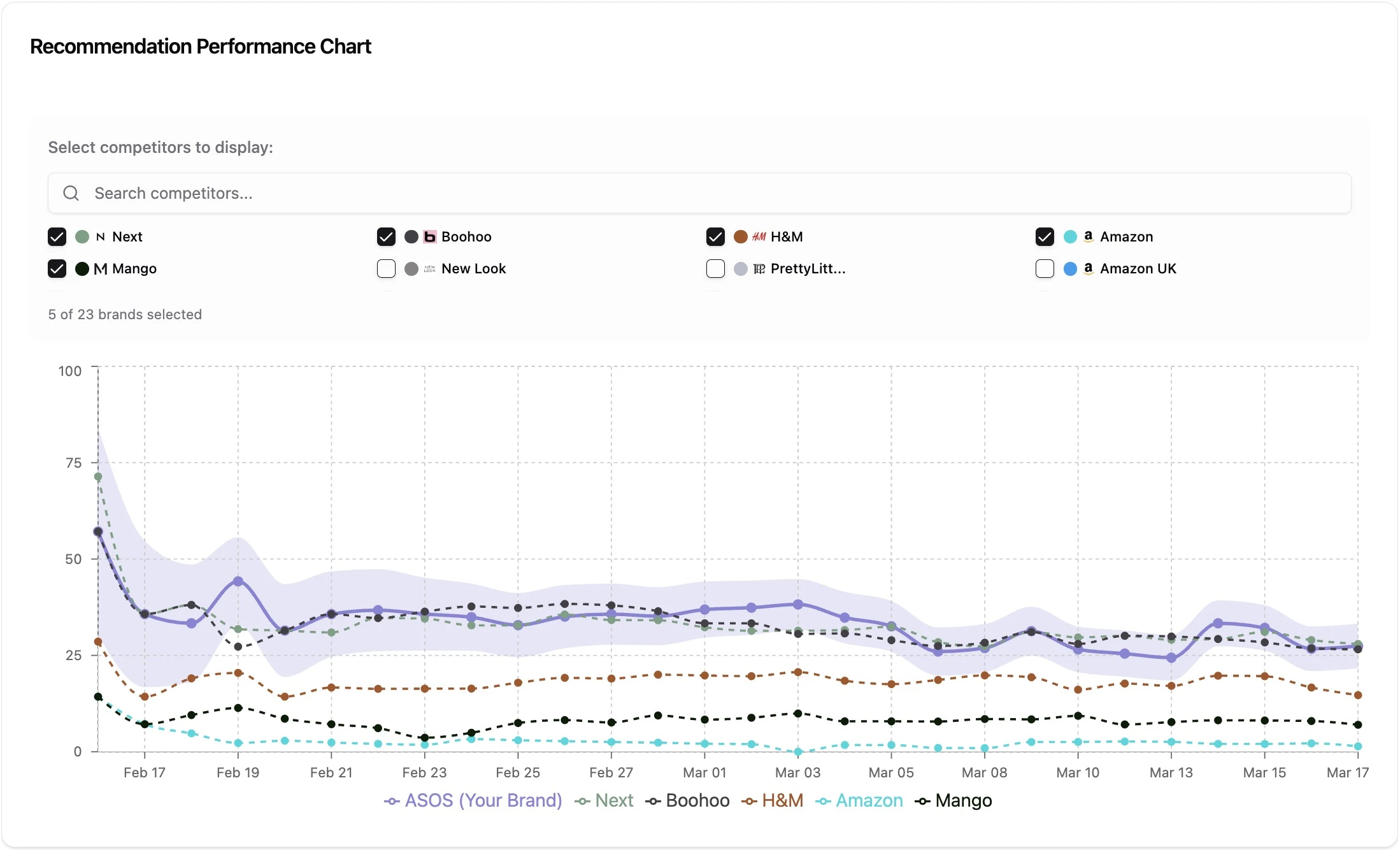
The true competitive impact of this difference is glaringly obvious in our Recommendation Performance Chart. When we strip away mere mentions and look solely at active AI endorsements, ASOS and Boohoo are actively outperforming major market players. Over a 30-day tracking period, ASOS and Boohoo consistently captured the top recommendation share, frequently dominating the competitive set. In stark contrast, massive competitors like Next, H&M, Mango, and Amazon consistently languish at the bottom of the chart, struggling to convert any baseline visibility they might have into actual, actionable AI recommendations.
While Amazon or H&M might frequently appear in an AI's conversational output, they are actively losing the zero-click conversion to ASOS. This Genezio case study proves that dominating the Recommendation Performance Chart, not just visibility metrics, is what truly drives consumer action, keeping the ultimate focus exactly where it belongs: winning the AI Recommendation is the critical goal for modern brands.
How Different AI Engines Calculate "Recommendation"
Different AI engines apply distinct methodologies to calculate what constitutes a "recommendation," reflecting their underlying architectures and strategic priorities.
- ChatGPT (OpenAI with Bing RAG Integration): ChatGPT blends conversational consensus with Retrieval-Augmented Generation from Bing, synthesizing diverse sources to provide balanced, conversationally coherent answers. It weighs aggregated sentiment, broader contextual relevance, and consensus across data pools, enabling brands like ASOS to be recommended based on positive holistic signals rather than only authoritative citations.
- Perplexity AI: Perplexity emphasizes real-time, transparent citations with a hyper-focus on authoritative domains. It prefers brands mentioned in highly credible, topical sources, weighing freshness and explicit references above conversational consensus. A brand like ASOS might only be mentioned here if not currently featured in top authoritative real-time citations, hence lacking a firm recommendation.
- Google Gemini: Google Gemini deeply integrates Google’s Knowledge Graph and Merchant Center data, leveraging structured product information, user reviews, and transactional signals. It favors brands with rich, verified schema markup and comprehensive merchant data, directly tying recommendation to Google's vast, structured ecosystem.
Why ASOS Might Be Recommended on ChatGPT but Only Mentioned on Perplexity ASOS’s broad positive brand sentiment, community discussion, and well-rounded data may trigger a strong recommendation on ChatGPT, which values conversational consensus. Conversely, Perplexity’s strict requirement for authoritative, real-time citation from top domains may cause ASOS to register only as a mention until those citations accumulate.
Why Tracking Engine Discrepancies Matters Understanding these nuanced differences across AI engines is critical for a unified AEO strategy. Brands must track their "AI Recommendation" footprint distinctly per engine, recognizing gaps and addressing the unique data and content ecosystems each AI relies on to optimize cross-platform recommendation dominance.
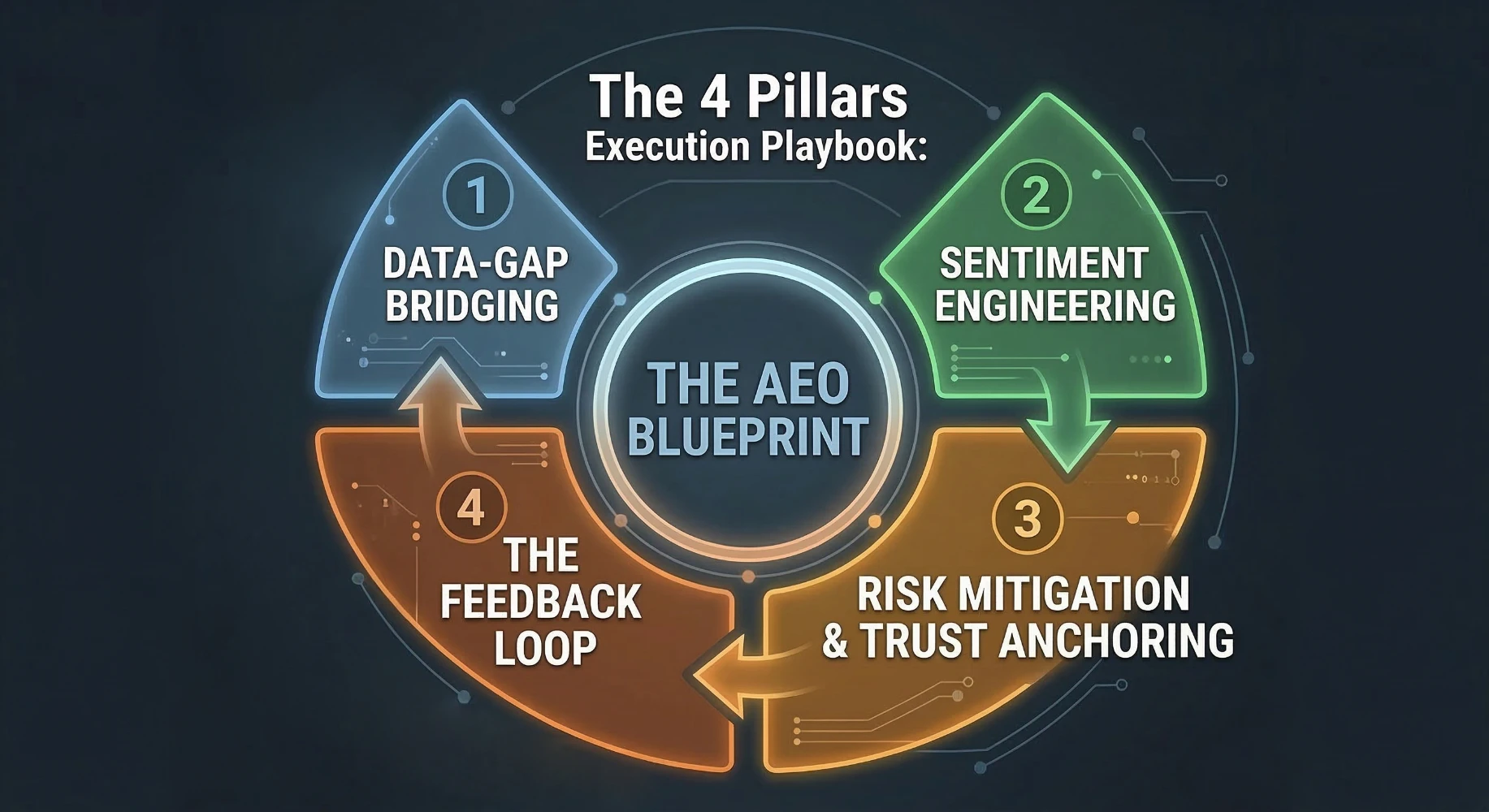
The 4 Pillars Execution Playbook: The AEO Blueprint
1. Data-Gap Bridging
- Identify missing or insufficient features (e.g., "sustainable packaging") causing AI hesitation.
- Publish detailed, consistent information via multiple channels:
- Schema markup on product pages
- Thought leadership content and FAQs
- Social platforms like Reddit and targeted PR to generate authentic, credible mentions
2. Sentiment Engineering
- Flood high-authority review sites and key forums with positive, context-rich customer feedback.
- Address caveats or negative sentiment proactively with transparent communication and user education.
- Use earned media and influencer endorsements to add credible third-party validations.
3. Risk Mitigation & Trust Anchoring
- Address the "Risk Aversion" pillar: LLMs are programmed to avoid recommending brands with ambiguous policies. Eliminate this risk by standardizing your terms of service, return policies, and customer support channels across all platforms.
- Anchor your narrative: Ensure your structured data directly links to highly trusted, authoritative entities (like verified Google My Business profiles or industry-standard certifications) to act as a definitive shield against AI hallucinations and false caveats.
4. The Feedback Loop
- Employ continuous brand mention and recommendation tracking tools like Genezio.
- Analyze shifts in LLM opinion post-content updates.
- Iterate content, data, and PR strategies dynamically based on real-time insights to continuously improve recommendation share.
New KPIs of AEO: Why Recommendation KPI is the New Gold Standard
Marketers traditionally measure "Share of Voice" (SOV) and "Search Volume" to gauge visibility and brand interest. However, in the AI-first era, these metrics capture only early-stage awareness.
Recommendation emerges as the critical KPI, measuring how often an AI explicitly endorses your brand as the preferred choice. Unlike SOV, which tracks mere mentions, Recommendation index correlates with bottom-of-funnel conversion intent and directly influences purchasing decisions.
AI Recommendations function as autonomous sales agents, guiding users toward a definitive decision and increasing conversion likelihood by delivering trusted endorsements at the moment of intent. For CMOs focused on growth, investing in Recommendation tracking and optimization delivers tangible revenue impact by closing the gap between discovery and purchase, outperforming traditional SEO metrics centered on top-of-funnel traffic. Brands that elevate their recommendation share harness AI engines as dynamic revenue drivers, propelling scalable growth in competitive markets.
How to Win More AI Recommendations with Genezio
- Monitor Brand Mentions in AI Chatbots Continuously: Use Genezio’s real-time tracking to see how your brand is cited and what sentiment or caveats accompany the mentions. Avoid costly surprises from missed negative signals.
- Track Brand Mentions in AI Chatbots with Contextual Insights: Beyond mentions, understand the intent behind queries and buyer personas asking them. This insight guides tailored messaging that aligns with AI’s recommendation drivers.
- Employ Brand Mention Monitoring Tools that Provide Recommendation Data: Not all monitoring tools are created equal. Genezio’s unique value is in uncovering recommendation presence, not just mentions, a critical differentiator in modern AEO.
- Leverage LLM Output Monitoring Tools for Brand Safety and Narrative Control: Track how your brand is framed by AI outputs, reinforce trust signals, and correct misinformation instantly to protect brand equity.
- Optimize Content Using AI-Driven Strategies: Genezio provides concrete, prioritized content and citation improvement actions proven to increase your brand’s recommendation score.
The Collapsed Funnel: How AI Merges Discovery and Conversion
Traditional search funnels have segmented the customer journey into sequential stages, discovery, consideration, and decision, requiring users to search, click multiple links, read content, compare options, and then convert. This multi-step funnel often stretched the buyer’s path, demanding patience and effort.
Conversational AI fundamentally collapses this traditional funnel by delivering answers and brand endorsements instantly within a single prompt. When an LLM explicitly recommends a brand, it acts simultaneously as the awareness, consideration, and decision phase. This seamless fusion accelerates the buyer journey, drastically reducing friction.
Known as "Zero-Click Conversions," this phenomenon means the AI provides an immediate, trusted recommendation within its interface, eliminating the need for further clicks or exploration. Winning the AI Recommendation is thus equivalent to winning the entire funnel in one interaction. Brands that master this collapsed funnel capitalize on heightened user trust and intent focus, converting prospects in real-time at the moment of highest purchase interest.
Structured Data: The Native Language of LLMs
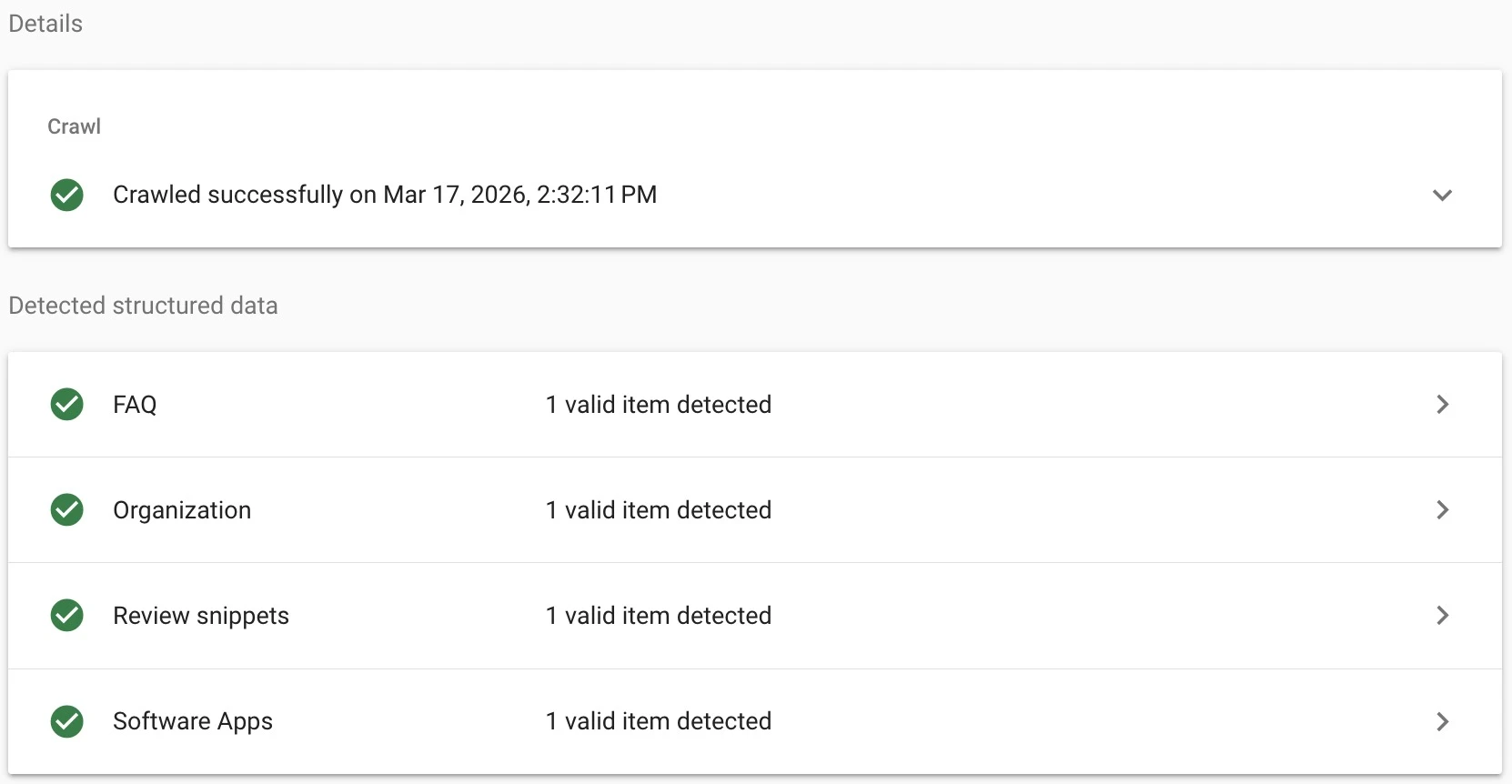
Large Language Models leverage Retrieval-Augmented Generation (RAG) mechanisms to ingest and interpret vast amounts of web data. While LLMs can parse plain text, structured data, such as Schema.org’s JSON-LD formats for Organizations, FAQs, and Software Applications, serve as a precise, machine-readable "API" that conveys information unambiguously.
Structured data enhances the AI's ability to link attributes, features, and semantics efficiently, reducing ambiguity that might arise from natural language alone. This clear, hierarchical data representation allows LLMs to extract relevant facts and context faster and with higher confidence.
For a brand aiming to advance from mere AI visibility to recommendation, providing clean, comprehensive, and standardized structured data is the critical technical foundation. It ensures the LLM aligns the brand’s features and value propositions directly with user queries, cementing trust and authority. Without this native "language," LLMs must rely on noisier textual inference, increasing the risk of omission, misinterpretation, or lower ranking in recommendation algorithms.
Mitigating AI Hallucinations
When LLMs lack dense, structured, and authoritative information about a brand, they tend to fill these knowledge gaps with hallucinations, fabricated or inaccurate details generated to complete responses. Such hallucinations expose brands to serious reputation risks, misinformation, and loss of control over their narrative.
Proactive Artificial Engine Optimization (AEO) serves as a protective shield against these risks. By feeding AI ecosystems with consistent feature matching and sentiment-engineered content, brands anchor the AI’s semantic vectors to factual, controlled narratives. This anchoring minimizes false caveats and reduces the propensity for AI hallucinations, thereby elevating brand safety. Through deliberate optimization for AI recommendation, brands maintain authoritative presence in conversational AI outputs, safeguarding trust and customer confidence.
Conclusion: The Call to Action for Brands
The era of generative AI demands a shift in marketing KPIs and brand monitoring tactics. Being mentioned by ChatGPT or other AI chatbots is no longer enough. To truly leverage the AI revolution, brands must:
- Transition from focusing on AI Visibility to winning AI Recommendations.
- Monitor not just brand mentions in AI chatbots but recommendation share of voice.
- Use advanced tools like Genezio that track, analyze, and optimize LLM outputs with actionable insights.
- Build trust and authority in AI conversations that decisively influence customer decisions.
As AI engines become primary channels for purchase decisions, your brand’s future growth depends on its ability to be explicitly recommended when it matters most.
Get started with Genezio today, turn AI visibility from a vanity metric into a strategic revenue growth engine.
Frequently Asked Questions (FAQ)
What is the main difference between AI Visibility and AI Recommendation? AI Visibility simply means your brand is mentioned or listed by an AI model in response to a user's query, which doesn't guarantee endorsement and can sometimes include negative context. AI Recommendation, on the other hand, is a proactive, explicit endorsement by the AI, positioning your brand as the best or most suitable option to meet the user's specific intent, which significantly drives conversions.
Why are Large Language Models (LLMs) considered "zero-click gatekeepers"? LLMs act as zero-click gatekeepers because they synthesize vast amounts of information and provide direct, comprehensive answers right within the conversational interface. This eliminates the need for users to click through traditional search engine links ("10 blue links") to find what they are looking for, effectively collapsing the traditional discovery and conversion funnel.
How can brands successfully transition their strategy from SEO to Artificial Engine Optimization (AEO)? To succeed in AEO, brands must shift their focus from simple keyword matching to establishing semantic proximity and entity authority. This involves implementing robust structured data, accumulating authoritative third-party citations, proactively managing brand sentiment across the web, and aligning content tightly with complex, multi-turn user constraints to ensure LLMs confidently and explicitly recommend them.
