
Step-by-Step Guide to AI Visibility Analysis for Brands
Is your brand visible in AI conversations? Follow this step-by-step guide to analyze AI perception, configure geo-targeting, and refine your visibility strategy.

Finding clarity among rapidly shifting digital conversations can feel challenging for any tech brand. With artificial intelligence shaping how brands are perceived and discussed, focusing on precise brand objectives and personas is now essential. By mapping user insights and optimising AI analytic parameters, you gain actionable data to drive strategic visibility. Discover how step-wise refinement lets you confidently manage your organisational identity in global conversational platforms.
Table of Contents
- Step 1: Define Brand Objectives And Key Personas
- Step 2: Configure AI Analysis Parameters And Geo-Targeting
- Step 3: Simulate AI Interactions With Relevant Scenarios
- Step 4: Measure And Interpret AI Brand Visibility Results
- Step 5: Refine Strategy Based On Verified Insights
- Brand Visibility Analysis Methodology
Quick Summary
| Key Point | Explanation |
|---|---|
| 1. Define Clear Brand Objectives | Establish specific goals to guide your AI visibility strategy effectively. Knowing your objectives solidifies your brand's identity in AI platforms. |
| 2. Implement Granular Persona Development | Create detailed user personas that encompass psychological and contextual attributes, enhancing your brand's communication strategy. |
| 3. Regularly Configure AI Parameters | Consistently update analysis settings and geo-targeting to adapt to regional variations in consumer engagement and perceptions. |
| 4. Conduct Realistic AI Interaction Simulations | Test varied scenarios to understand potential communication gaps and refine your AI messaging before public roll-out. |
| 5. Continuously Refine Strategy Based on Insights | Utilize analytical feedback to make informed adjustments to your communication approaches, ensuring relevance and effectiveness in your messaging. |
Step 1: Define brand objectives and key personas
Defining precise brand objectives and key personas is crucial for creating meaningful AI visibility strategies. This foundational step enables brands to understand how artificial intelligence platforms perceive and represent their organisational identity.
The process begins by systematically mapping out your brand's core strategic goals and identifying the specific user segments most relevant to your market positioning. Systematic persona development helps brands capture nuanced user behaviours and needs, transforming abstract marketing concepts into actionable insights.
Key steps in defining brand objectives and personas include:
- Conduct comprehensive market research
- Analyse current brand perception
- Identify target audience demographics
- Create detailed persona profiles
- Map user journey and interaction points
When developing personas, focus on creating multidimensional representations that go beyond basic demographic data. Capture psychological attributes, professional contexts, and potential interaction scenarios with AI platforms.
Effective persona development transforms abstract user data into strategic communication insights.
By meticulously defining your brand objectives and personas, you establish a robust framework for understanding how AI systems might interpret and represent your organisational identity across various conversational interfaces.
Professional Insight: Invest time in researching granular user segment details to create more accurate and compelling AI personas.
Step 2: Configure AI analysis parameters and geo-targeting
Configuring precise AI analysis parameters and geo-targeting represents a critical phase in understanding your brand's digital visibility across different regional contexts. This step transforms raw data collection into strategic intelligence that reveals how AI platforms perceive and represent your brand.

Optimising AI parameter settings allows brands to enhance monitoring precision and uncover nuanced insights about regional consumer engagement. The process involves selecting sophisticated tracking mechanisms that capture contextual variations in brand representation.
Key configuration parameters include:
- Define geographical targeting scopes
- Select language and regional dialects
- Set demographic filtering criteria
- Choose conversation context types
- Establish interaction frequency thresholds
When implementing geo-targeting strategies, consider multiple dimensions beyond basic location data. Explore cultural nuances, linguistic variations, and regional communication patterns that might influence AI perception.
Sophisticated geo-targeting transforms generic brand monitoring into a precise, regionally contextualised intelligence tool.
Successful configuration requires a granular approach that balances technical precision with strategic insight, enabling your brand to understand its digital representation across diverse conversational landscapes.
Professional Insight: Regularly recalibrate your AI analysis parameters to maintain accuracy and capture evolving market dynamics.
Step 3: Simulate AI interactions with relevant scenarios
Simulating AI interactions offers a sophisticated method for brands to anticipate and strategically manage their digital representation across conversational platforms. This critical step allows you to proactively understand how artificial intelligence systems might interpret and communicate your brand's core messaging.
AI simulation frameworks enable brands to model complex consumer interaction scenarios, revealing potential visibility challenges and communication nuances. The process involves creating multi-dimensional conversation scenarios that test your brand's AI representation across different contextual environments.
Key simulation strategies include:
- Design diverse conversation scenarios
- Test multiple interaction personas
- Evaluate response consistency
- Analyse language adaptation capabilities
- Measure contextual understanding depth
When developing simulation scenarios, focus on crafting realistic conversational contexts that reflect genuine user interactions. Consider variations in user intent, emotional tone, and specific industry-related queries that might reveal subtle communication gaps.
Effective AI interaction simulations transform potential communication risks into strategic opportunities for brand refinement.
Through meticulous scenario testing, brands can identify potential misrepresentations, linguistic inconsistencies, and perception gaps before they manifest in real-world conversational platforms.
Professional Insight: Regularly update your simulation scenarios to reflect emerging communication trends and evolving AI language models.
Step 4: Measure and interpret AI brand visibility results
Measuring and interpreting AI brand visibility results transforms raw data into strategic marketing intelligence. This critical stage helps you understand how artificial intelligence platforms perceive and represent your brand across diverse digital landscapes.
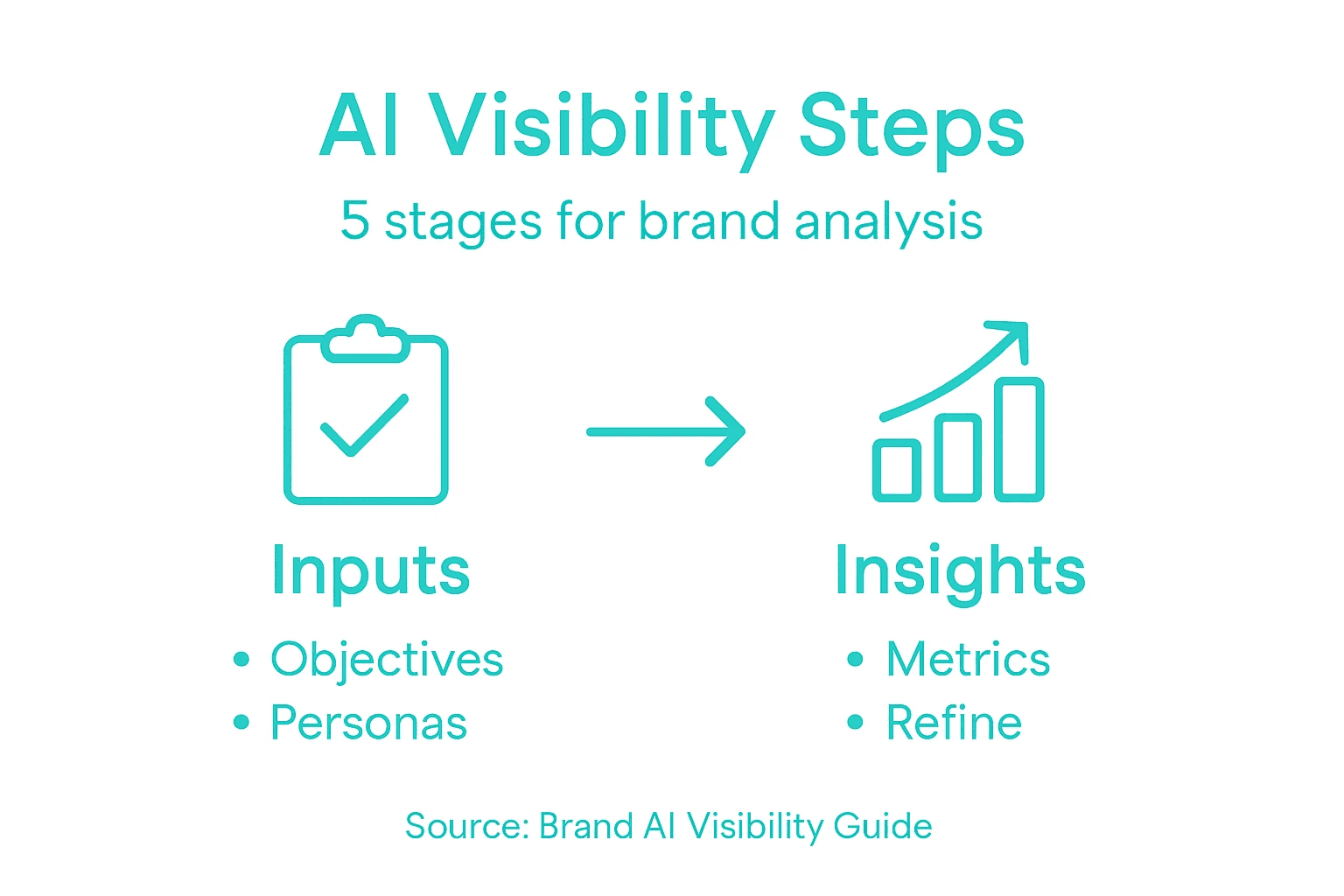
Comprehensive brand visibility metrics provide marketers with nuanced insights into digital brand representation. The process involves systematically analysing quantitative and qualitative outputs to decode the complex narrative surrounding your brand's AI visibility.
Key measurement and interpretation strategies include:
- Establish baseline performance indicators
- Compare cross-platform visibility metrics
- Evaluate contextual brand mentions
- Analyse sentiment and perception trends
- Identify potential communication gaps
When interpreting results, focus on understanding the underlying narrative beyond numerical data. Examine how AI systems contextualise your brand, considering linguistic nuances, emotional tone, and potential misrepresentations that might impact brand perception.
Effective AI visibility analysis transforms complex data points into actionable strategic insights.
Successful interpretation requires a holistic approach that balances statistical analysis with contextual understanding, enabling brands to proactively manage their digital representation.
Here is a comparison of qualitative vs quantitative AI visibility metrics:
| Metric Type | Example Output | Strategic Use |
|---|---|---|
| Quantitative | Frequency of brand mentions | Tracks brand awareness at scale |
| Qualitative | Sentiment analysis context | Uncovers narrative and perception trends |
Professional Insight: Develop a consistent measurement framework that allows for longitudinal tracking of your brand's AI visibility performance.
Step 5: Refine strategy based on verified insights
Refining your AI visibility strategy requires a systematic approach that transforms raw data into actionable marketing intelligence. This crucial stage enables brands to adapt and optimise their digital representation through evidence-based decision making.
Iterative strategy refinement processes help organisations validate AI-generated insights against real-world performance metrics. The approach involves continuously adapting brand communication strategies based on comprehensive analytical feedback.
Key strategy refinement techniques include:
- Validate insights against market research
- Identify emerging communication patterns
- Prioritise high-impact strategic adjustments
- Develop targeted messaging improvements
- Establish continuous learning mechanisms
When implementing strategic refinements, focus on understanding the nuanced relationship between AI-generated insights and actual brand perception. Consider both quantitative metrics and qualitative contextual factors that might influence your brand's digital representation.
Strategic refinement transforms analytical insights into precise, adaptive brand communication approaches.
Successful strategy evolution demands a flexible mindset that views AI insights as dynamic tools for continuous brand optimisation, rather than static recommendations.
Professional Insight: Create a dedicated feedback loop that allows rapid integration of new insights into your brand communication strategy.
The following table summarises how each stage of the AI brand visibility process contributes to overall organisational strategy:
| Stage | Primary Focus | Strategic Benefit |
|---|---|---|
| Define Objectives & Personas | User understanding and segmentation | Enables precise brand targeting |
| Configure Analysis & Geo-targeting | Regional insight and technical set-up | Reveals localised engagement patterns |
| Simulate AI Interactions | Scenario testing and optimisation | Identifies messaging gaps early |
| Measure & Interpret Results | Data collection and analysis | Informs actionable strategic decisions |
| Refine Strategy | Continuous improvement | Ensures sustained competitive advantage |
Brand Visibility Analysis Methodology
Now that you understand the step-by-step process, it is important to contextualise these actions within a broader, continuous methodology. This framework shifts traditional SEO into the realm of Large Language Models (LLMs), using a systematic approach to extract and quantify how AI perceives your brand across all the stages we just covered.
A comprehensive AI visibility methodology relies on moving beyond simple keyword tracking to evaluate complex conversational outputs. Key pillars include:
Unbiased Prompt Engineering: Crafting neutral, scenario-based prompts to test organic AI responses without leading the model.
Multi-Model Cross-Testing: Analysing your presence across major LLMs (such as ChatGPT, Gemini, and Claude) to capture a holistic market view.
Contextual Sentiment Scoring: Evaluating not just if your brand is mentioned, but whether it is framed positively, positioned as a primary recommendation, or simply listed as an alternative.
AI Share of Voice (SOV): Measuring the frequency and prominence of your brand's mentions against direct competitors within specific conversations.
Example in Action: If you represent a retail bank, your methodology might involve prompting three different LLMs with the unbiased query: "Which digital banks offer the best travel rewards and zero foreign transaction fees?" You would then record the data to see if your brand is recommended first, evaluate the sentiment of the AI's description (e.g., is your mobile app praised for ease of use?), and calculate how often you appear compared to competitors like Monzo, Revolut, or Chase.
Take Control of Your Brand's AI Visibility Today
The challenge of understanding how AI platforms perceive and represent your brand is more critical than ever. This article highlights the importance of defining precise brand objectives, applying geo-targeted analysis, and simulating realistic AI interactions to reveal potential communication gaps. If you aim to transform these complex processes into actionable insights that enhance your brand presence across conversational AI, Genezio provides the perfect solution.
Genezio is an AI visibility platform designed to monitor and optimise your brand’s digital representation by analysing large language models through realistic customer personas and geographical data. By integrating your brand objectives with cutting-edge simulation and measurement tools, you can stay ahead of evolving AI narratives and fine-tune your strategy effectively. Start transforming your AI visibility strategy by exploring how Genezio’s platform can help you deepen consumer understanding and secure a competitive advantage. Visit Genezio now and experience precise AI brand insights that traditional SEO cannot deliver.
Frequently Asked Questions
What are the first steps in conducting AI visibility analysis for brands?
To begin, outline your brand's objectives and identify key personas that reflect your target audience. Conduct comprehensive market research and create detailed persona profiles to enhance your understanding of user behaviour and needs.
How do I configure AI analysis parameters for my brand’s visibility study?
Configure AI analysis parameters by defining geographical targeting scopes, selecting relevant languages, and setting demographic filtering criteria. Focus on creating a contextual framework that reveals how AI platforms perceive your brand within different regional environments.
What is the purpose of simulating AI interactions in this analysis process?
Simulating AI interactions allows you to anticipate how AI systems might interpret your brand’s messaging across various scenarios. Design diverse conversation scenarios to test these interactions and gain insights into potential misrepresentations before they occur.
How can I effectively measure my brand's AI visibility results?
Measure AI brand visibility by establishing baseline performance indicators and evaluating both quantitative and qualitative metrics. Use these insights to decode your brand's narrative and identify any gaps in communication, then adjust your strategies accordingly.
What steps should I take to refine my visibility strategy based on AI insights?
To refine your AI visibility strategy, validate insights against real-world performance metrics and identify emerging communication patterns. Develop targeted messaging improvements and establish continuous learning mechanisms to optimise your brand’s digital representation over time.
Recommended
