
Visibility-to-Recommendation: AI Market Share is Shaped by Personas
To survive the shift driven by generative AI, brands must pivot from Share of Voice to the Visibility-to-Recommendation Rate (VRR).
For years, digital marketers have worshipped at the altar of Share of Voice (SOV). It was the ultimate metric for brand visibility. But right now, we are living through a massive structural shift driven by generative AI and Large Language Models (LLMs). As these engines dynamically personalize user experiences, flat metrics like SOV are quickly becoming obsolete.
To survive this shift, brands need to fundamentally rethink how they measure visibility. The focus must pivot to the Visibility-to-Recommendation Rate (VRR).
As an active practitioner of Artificial Engine Optimization (AEO), I want to share a framework that proves why your brand's AI market share is no longer a single, uniform number. Instead, it is fragmented across a complex web of user personas. Understanding this is the key to dominating AI-driven recommendation engines.
The End of Flat Metrics (From SOV to VRR)
Traditional SEO relies on Share of Voice, a surface-level metric that counts how often a brand is mentioned across keywords or channels. This approach assumes a flat visibility landscape where every user sees the exact same "10 blue links" on a search results page.
Generative AI doesn't work like that. When a user chats with an AI assistant, they don't get a generic list of links. They get a highly synthesized, personalized narrative built around their specific context.
Because of this, the old rules no longer apply:
- A simple tally of brand mentions doesn't reflect actual market dominance.
- Your brand might be referenced frequently, but rarely recommended as the definitive solution.
- Visibility without an explicit endorsement actively drains your market share.
This is why SOV's proportional allocation is ending. Instead, the new gold standard is the Visibility-to-Recommendation Rate (VRR). This metric measures the percentage of times a brand is explicitly endorsed by the AI as the absolute best choice for a specific user out of all the times it was considered.
Why does this matter commercially?
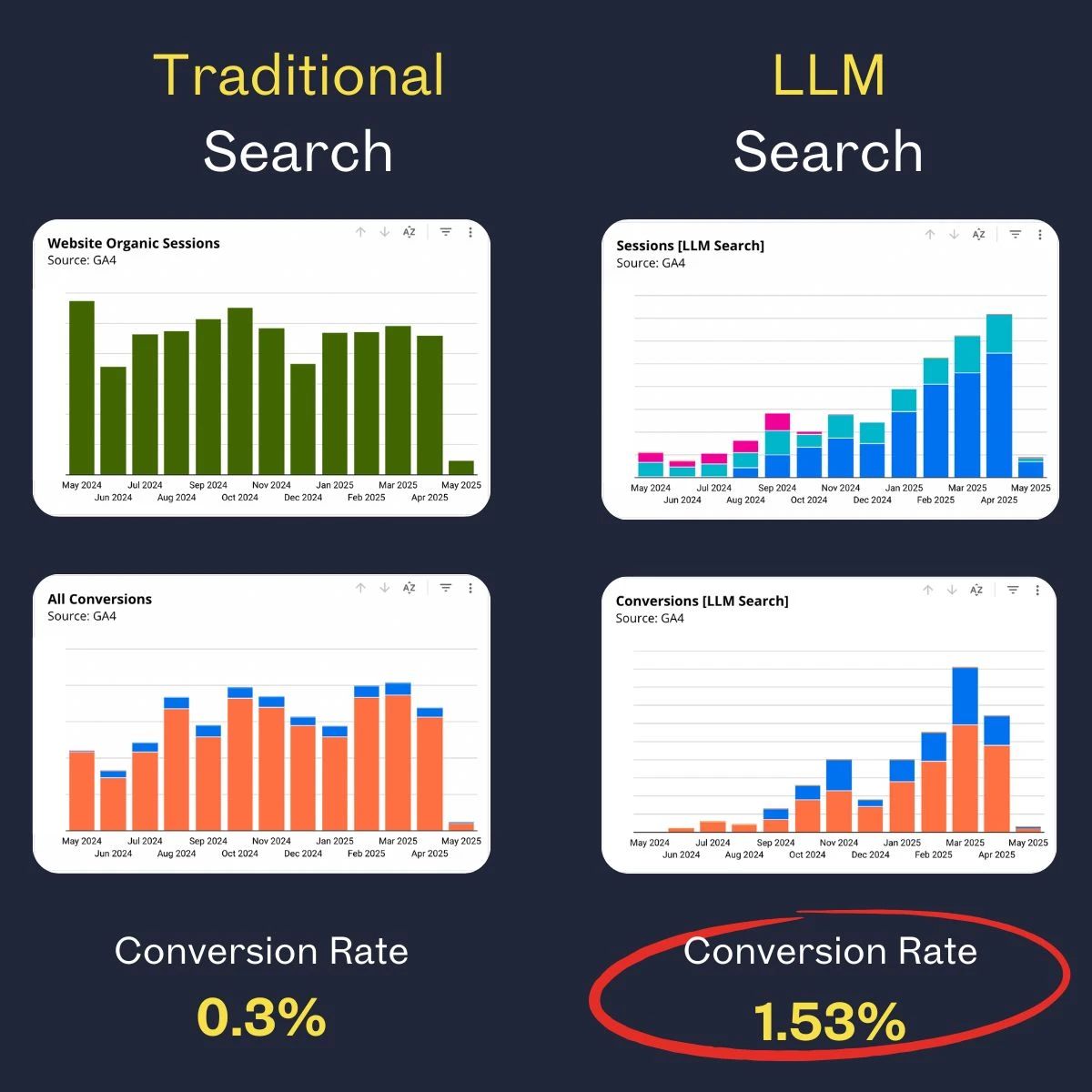
Industry data shows that users who receive an explicit recommendation from an AI assistant convert 5 times better than those clicking through traditional search results.
By offering a direct recommendation, the AI entirely removes decision fatigue, essentially acting as a highly trusted, autonomous consultant. VRR doesn't just capture passive visibility; it measures high-intent advocacy.
The Platform Advantage: How We Measure VRR
Capturing this massive 5x conversion opportunity requires moving past basic SEO tools. Our Generative Engine Optimization (GEO) platform was natively built to measure and optimize VRR with surgical precision, leveraging three core capabilities:
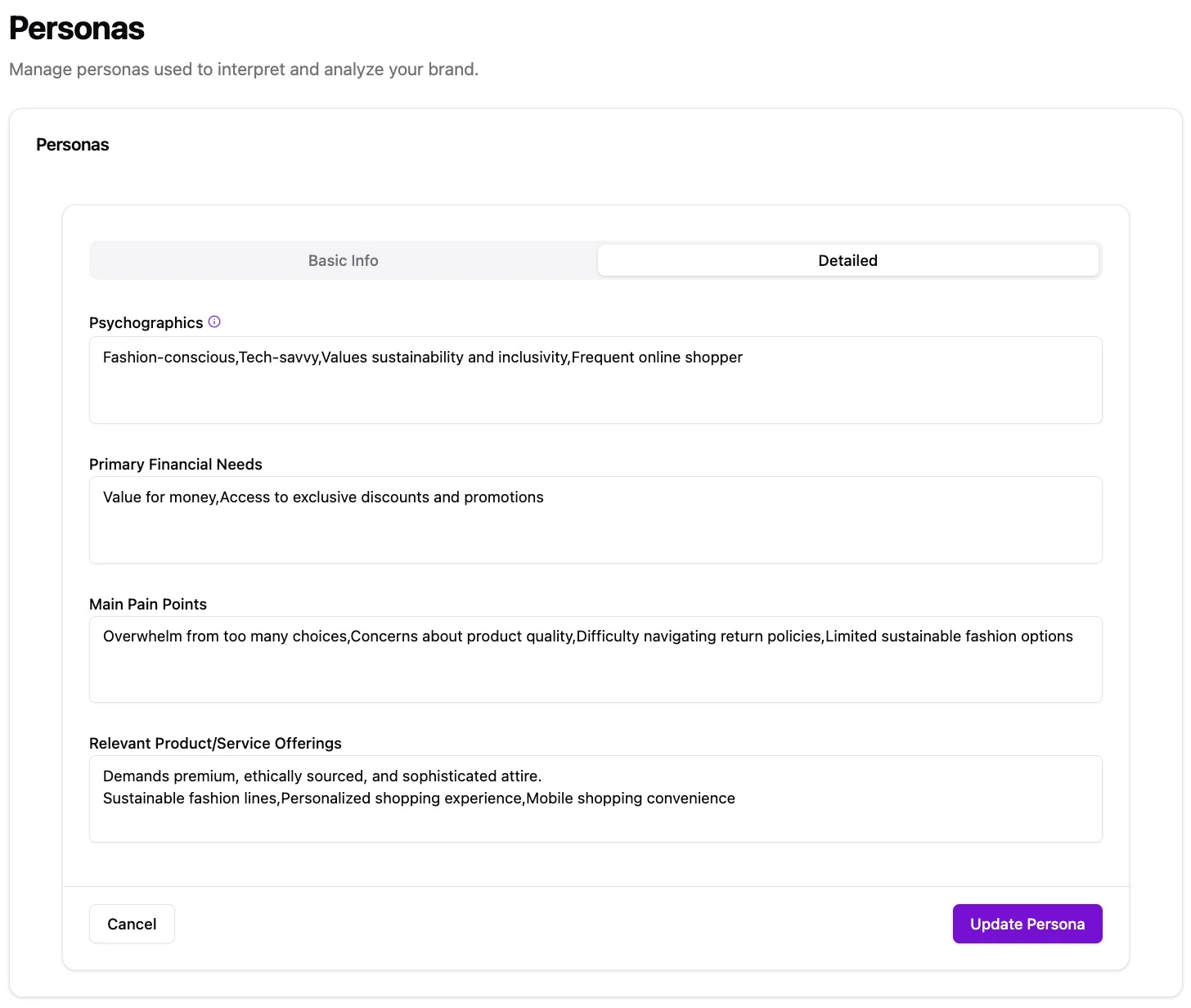
- Advanced Persona Configurations: We don't just track static keywords. Our platform allows you to configure highly detailed user personas (using our dedicated Personas module), integrating real-world constraints like financial needs, psychographics, and specific pain points.
- Multi-Turn Conversations: Real users don't stop after one prompt. We calculate recommendations by tracking brand visibility across complex, multi-turn conversations. This allows us to see if the AI defends and maintains its recommendation of your brand as the user asks follow-up questions.
- Specialized AI Agents: To accurately audit LLM algorithms, we deploy two specialized agents. The "Recommender" agent forces the AI model to filter through the noise and present the absolute best option for a specific need. Meanwhile, the "Comparer" agent pits two rival brands head-to-head, forcing the AI to analyze, contrast, and declare a single, clear winner.
The Structural Shift: From SERP to Zero-Sum Visibility
To really grasp why SOV is failing, you have to look at the architecture of a traditional Search Engine Results Page (SERP) versus an LLM response.
A SERP is discrete. It presents a set of links, each taking a predictable slice of user attention. We know that Position 1 grabs about 30% of clicks, Position 2 gets 15%, and so on. It’s a proportional game where brands fight for incremental ranking bumps.
LLMs, however, synthesize information into a single, cohesive answer. The AI frequently crowns one brand as the "best" fit for the user's unique context. We call this Zero-Sum Visibility. The AI consolidates visibility into a singular narrative rather than distributing it across 10 links. If the AI recommends your competitor as the definitive solution, your effective market share for that specific interaction plummets to zero.
The Psychology of LLMs: Persona-Driven Context
So, how does the AI decide who wins? Through advanced semantic context parsing, LLMs implicitly construct user personas on the fly. When a user types a prompt, the model dynamically detects a constellation of constraints, budget, location, ethics, aesthetics, that form a unique persona.
Example: Gen-Z Festival Goer vs. Corporate Executive Imagine two vastly different people querying "UK Fashion":
- A Gen-Z festival goer wants trendy, budget-conscious, and expressive brands.
- A Corporate Executive needs premium, ethically sourced, and sophisticated office wear.
Even though the baseline interest is the same, the LLM parses these distinct features and tailors its recommendations accordingly. Your brand’s AI market share is essentially a matrix of micro-market shares, depending entirely on how well your data aligns with these specific contexts.
The Methodology: Fanout Queries in AEO
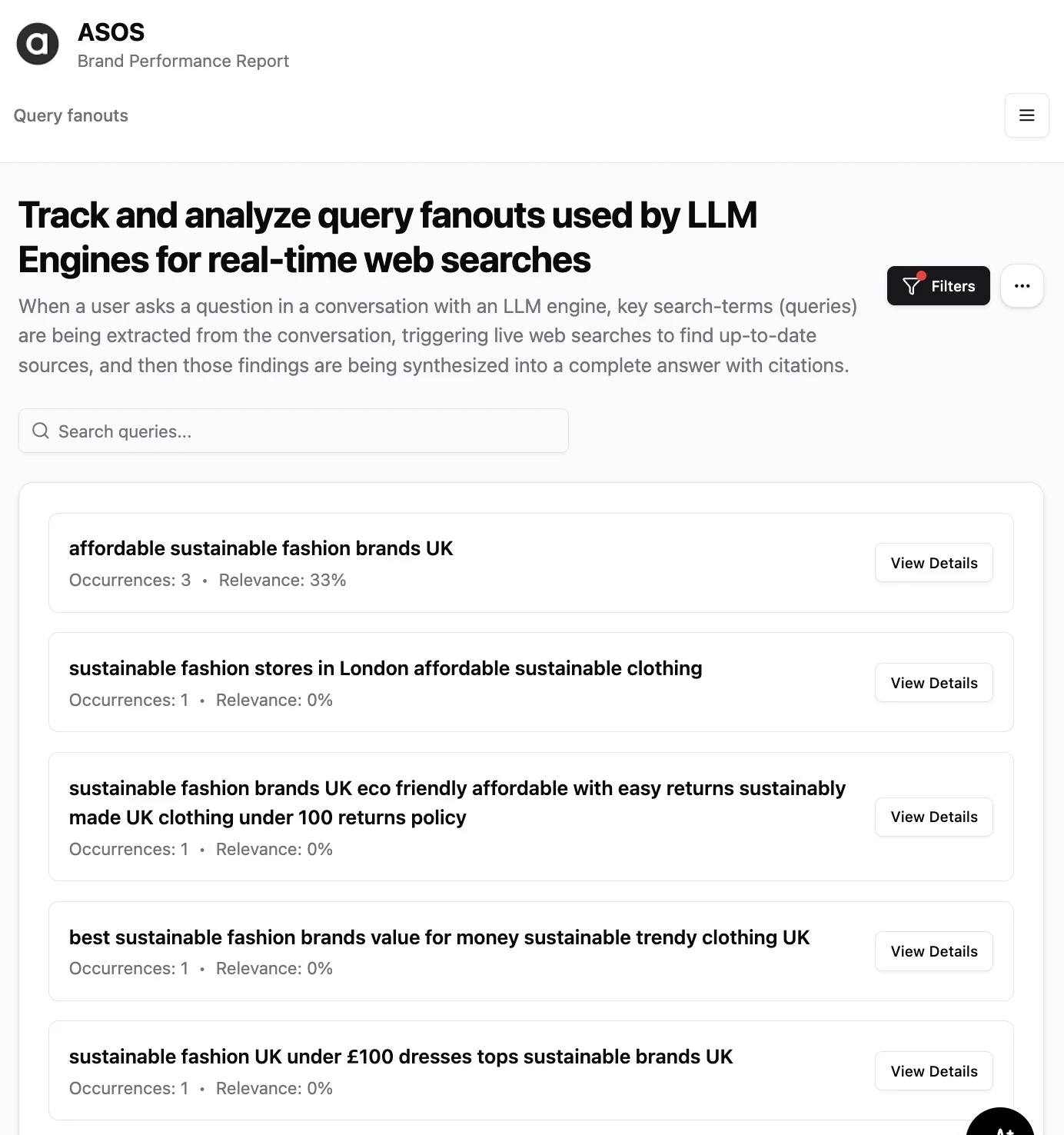
To optimize for this, marketers use a Fanout Query. This is a strategic method of taking a core topic and expanding it into a wide spectrum of hyper-specific prompt scenarios.
If your base topic is "Sustainable Fashion," an effective fanout strategy adds explicit modifiers like:
- "affordable"
- "easy returns"
- "value"
- "eco friendly"
By iteratively feeding these diverse, persona-driven prompts to an LLM, you can map the AI's decision tree. This reveals the exact thresholds where your brand’s VRR grows or drops, giving you the data you need to fix your brand narrative.
The VRR Hierarchy: 3 Dimensions of Consistency
As AEO evolves, we need to understand the hierarchy of AI presence:
- Indexed: You passively exist in the LLM's training data.
- Cited: You appear as a passing reference, but hold no decision-making power.
- Suggested: You are listed as one of several viable options.
- Recommended: You are explicitly framed as the preferred, winning option.
But hitting "Recommended" once isn't enough. A high VRR must be stable across three dimensions:
- Prompt Variability Consistency: Does the AI still recommend you if the user phrases the question differently?
- Temporal Consistency: Does the recommendation survive algorithm updates and new training data drops?
- Platform Consistency: Are you recommended across different engines (ChatGPT, Perplexity, Gemini)?
The Theory in Action: Mapping the UK Fashion Matrix
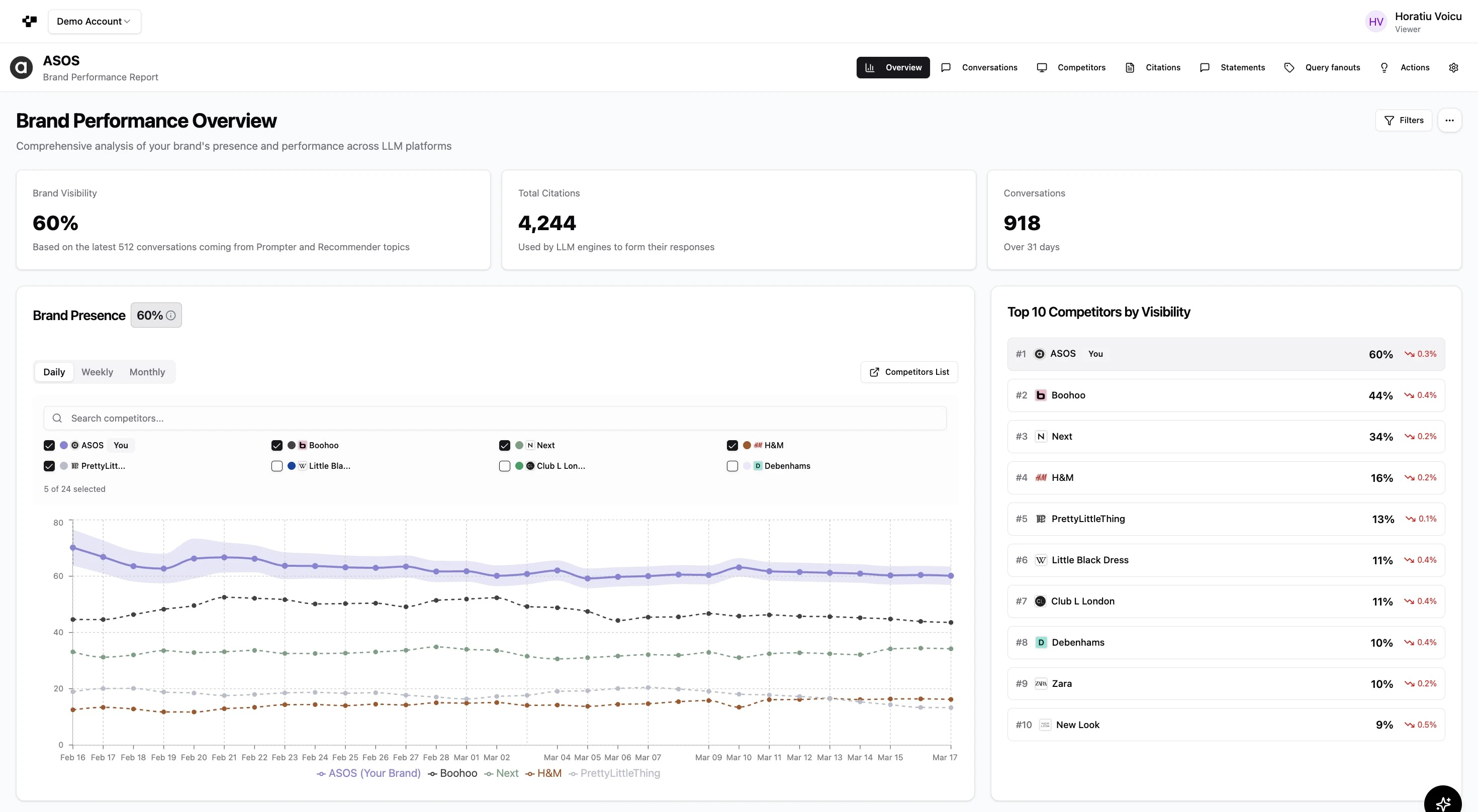
This isn't just theory. We utilized our platform to map LLM recommendation patterns within the highly competitive UK Fashion sector. We generated a rigorous matrix of 1,869 unique query fanout permutations and analyzed 918 distinct, multi-turn LLM conversations over a 31-day period.
Examining our platform's 'Scenarios' data reveals how semantic context parsing operates. For instance, we tracked the micro-market share of a "social media manager" seeking "stylish workwear" with a strict "budget under £100 per piece," demanding "sustainable fabric choices" and "clear return policies" in London. Simultaneously, we ran tests for a "festival season" shopper prioritizing "inclusivity," "eco-friendly brands," and "fast delivery."
The resulting data from these 1,869 experiments illustrates the current dynamics of AI ecosystems. Looking at our Top 10 Competitors by Recommendation data, AI market share in the UK fashion sector appears polarized.
| Brand | Market Position | Visibility-to-Recommendation Rate (VRR) | AI Visibility Status |
|---|---|---|---|
| ASOS | Digital Native / AI Dominator | 46% | Consistent Explicit Endorsement |
| Boohoo | Digital Native / AI Dominator | 35% | Consistent Explicit Endorsement |
| Next | Legacy / Strong Adapter | 24% | High Recommendation Rate |
| H&M | Legacy / Struggling | 20% | Moderate / Fragmented Endorsement |
| Mango | Legacy / Vulnerable | 4% | Passive Indexing / Zero-Sum Visibility |
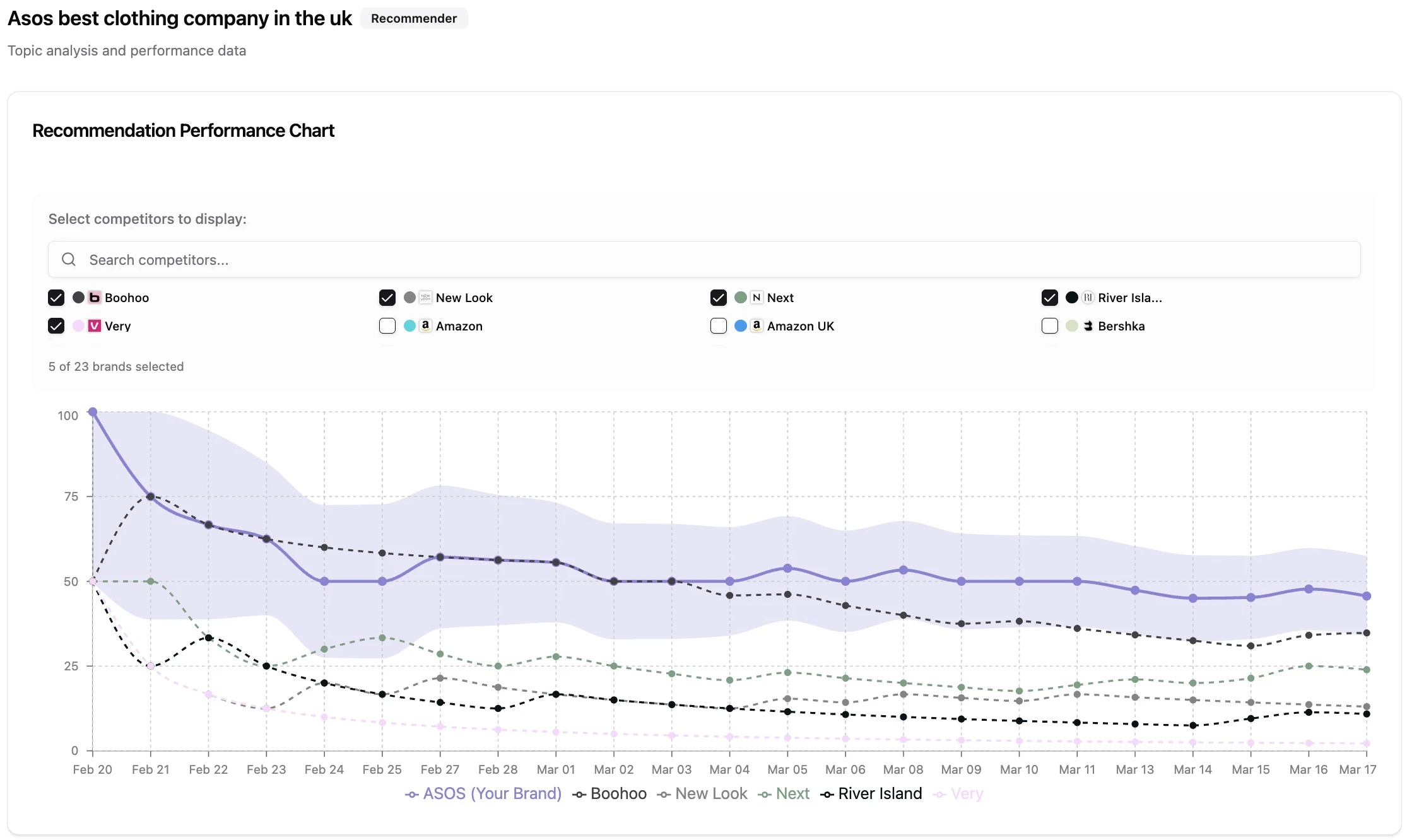
When we tracked VRR across these intent-driven personas, ASOS and Boohoo actively dominated, capturing a 46% and 35% VRR, respectively. Because their underlying brand data perfectly aligns with complex prompt vectors, the AI consistently crowned them the winners.
Conversely, legacy brands suffered. H&M sits at a 20% VRR, while Mango practically flatlined at a 4% recommendation rate. They might be passively indexed thousands of times, but they fail to secure explicit endorsements. In the Zero-Sum game of LLMs, being visible without being recommended means you are losing.
Conclusion: Navigating the Generative Paradigm
The shift from Share of Voice (SOV) to Visibility-to-Recommendation Rate (VRR) is a fundamental evolution in marketing. Generative AI engines are actively replacing flat search results with hyper-specific, persona-driven endorsements.
To survive, brands must transition to Artificial Engine Optimization (AEO). By deploying automated fanout queries, utilizing specialized AI agents, and rigorously tracking VRR across multi-turn conversations, you can reverse-engineer the recommendation process. The goal is no longer just to be seen; it is to secure the explicit, context-aligned endorsement that drives 5x higher conversions.
Frequently Asked Questions (FAQ)
1. What is the fundamental difference between Share of Voice (SOV) and Visibility-to-Recommendation Rate (VRR)? SOV measures how often a brand is passively mentioned across keywords, assuming a traditional search environment where users view multiple links. VRR measures the percentage of times an AI explicitly endorses a brand as the definitive best choice out of all the times it was considered, tracking how stable that endorsement is across varying prompts, time, and AI platforms.
2. Why does VRR impact revenue more than traditional search metrics? Data shows that users who receive an explicit recommendation from an AI assistant convert 5 times better than those navigating traditional search results. The AI acts as a trusted consultant, removing decision friction. VRR directly measures your ability to capture these high-intent, high-converting users.
3. What is a "Fanout Query" in Artificial Engine Optimization (AEO)? A Fanout Query takes a core topic (e.g., "Sustainable Fashion") and expands it into hundreds of permutations by adding contextual constraints (e.g., "under £100," "London delivery"). This allows marketers to map exactly how AI models recommend brands across diverse user personas.
4. How does Genezio track VRR differently than other tools? Unlike basic keyword trackers, our platform measures VRR by configuring advanced user Personas and tracking brand endorsements across complex, multi-turn conversations. We also use specialized AI agents (Recommender and Comparer) to force the LLM to make definitive choices, ensuring we measure true market dominance, not just passing mentions.
5. Why is "Zero-Sum Visibility" a critical concept in generative AI? Unlike search engines that provide 10 visible links, an LLM typically synthesizes an answer that highlights one definitive solution. If the AI explicitly recommends your competitor as the best fit for that specific query, your effective visibility and market power for that interaction drop to zero.
